Volkswagen ID.5 vs Volvo EC40: Style and Space Compared
Compare the Volkswagen ID.5 and Volvo EC40 on rear-seat comfort, rearward visibility and luggage space, and learn what exterior dimensions cannot reveal.
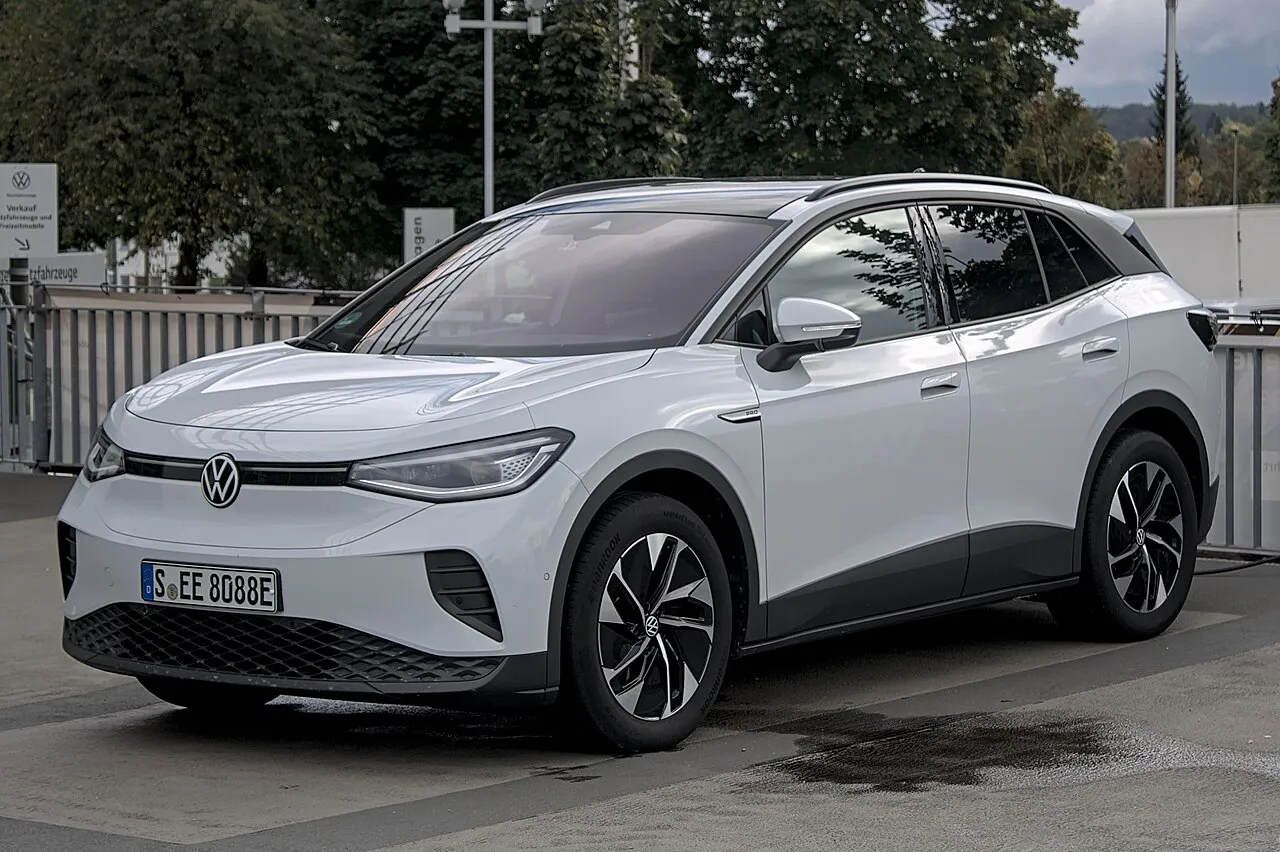
The short answer: The Volkswagen ID.5 has a longer, taller exterior than the European Volvo EC40 versions compared here, but that does not establish better rear headroom or more usable luggage space. Both coupe-shaped SUVs make the roofline central to their styling; the practical tradeoffs depend on seat placement, rear-window geometry and the shape beneath the hatch.
The Volkswagen ID.5 offers a longer, taller exterior than the European Volvo EC40 versions compared here, giving it a larger overall envelope in which to accommodate passengers and luggage. That does not establish a winner for rear headroom, rearward visibility or cargo usefulness. Both use a sloping roof to create their coupe-shaped profiles, and the practical result depends on how the cabin, glass and hatch fit beneath that outline.
The useful distinction is between exterior size and usable space. Roof height matters, but so do the position of the rear seat and the thickness of the structure above it. Cargo capacity matters, but so does whether a particular suitcase can pass through the hatch and stand where it needs to. These details determine whether the styling suits everyday use.
What the exterior dimensions establish
OpenEV Data and EVDB give the European-market, model-year 2025 ID.5 Pro and GTX the same exterior dimensions. OpenEV Data gives the equivalent-year European EC40 Base and Base Twin Motor a shorter, slightly lower body. EVDB records slightly different width and height figures for the European EC40 Single Motor Extended Range, so those versions should remain distinct.
| Vehicle and version | Market and model year | Length | Width | Height | Wheelbase | Measurement context | Source |
|---|---|---|---|---|---|---|---|
| Volkswagen ID.5 Pro and GTX | Europe, 2025 | 4,599 mm | 1,852 mm | 1,618 mm | 2,765 mm | Exterior dimensions; EPA, WLTP and NRCan range-test standards do not apply | OpenEV Data and EVDB |
| Volvo EC40 Base and Base Twin Motor | Europe, 2025 | 4,440 mm | 1,863 mm | 1,591 mm | 2,702 mm | Exterior dimensions; EPA, WLTP and NRCan range-test standards do not apply | OpenEV Data |
| Volvo EC40 Single Motor Extended Range | Europe, 2025 | 4,440 mm | 1,873 mm | 1,596 mm | 2,702 mm | Exterior dimensions; EPA, WLTP and NRCan range-test standards do not apply | EVDB |
The ID.5 is longer and has a longer wheelbase, while these EC40 versions are slightly wider. Those relationships describe the vehicles' proportions; they do not measure passenger accommodation. Additional length can be distributed among the cabin, luggage compartment and body structure. Likewise, exterior width includes space that cannot be used by occupants or luggage.
These are European versions, and the measurements should not automatically be assigned to American-market cars. Their value here is to establish the broad packaging comparison, without treating exterior dimensions as a substitute for interior measurements.
Rear headroom depends on where the roof slopes
A coupe-shaped SUV's roofline can descend toward the rear without taking the same amount of space from every passenger. The critical relationship is between the passenger's head and the roof directly above it. Maximum vehicle height describes the highest exterior point, which may be well forward of the rear seating position.
The ID.5's taller body therefore offers a potential packaging advantage, rather than proof of greater clearance above a rear passenger. Seat height, cushion shape, backrest angle and the interior roof lining all affect that clearance. A lower seat can create more room overhead, but it also changes the relationship between a passenger's hips, knees and feet.
This is why headroom and comfort should be considered together. A passenger may fit beneath the roof yet find the seating posture uncomfortable. Conversely, a seat with an agreeable backrest angle can place the head differently beneath the slope. A simple judgment based on whether hair touches the roof misses the broader question of whether the passenger can sit naturally.
The longer wheelbase of the European ID.5 also cannot settle the issue. Wheelbase measures the distance between the axles, not the space between the front and rear seats. It gives designers a different starting point, but seat placement and the surrounding structure determine how much of that length passengers actually receive.
Entry and exit introduce another constraint. A seated passenger occupies a different space from someone moving through a door opening. The roof edge and upper door frame can require a person to duck even when the seat itself accommodates them comfortably. For either vehicle, rear-seat suitability therefore involves both the resting position and the path into it.
Rearward visibility is a question of geometry
A falling roofline influences the space available for rear glass, but the exterior silhouette alone does not reveal the driver's view. Rear-window height, its angle, the surrounding pillars and the driver's eye position all matter. The relevant question is how much of the scene behind the vehicle remains visible from the normal driving position.
An inclined window can have substantial surface area while presenting a shallower opening to the driver's line of sight. That distinction helps explain why a dramatic rear profile and an open rearward view do not necessarily go together. It also prevents an unsupported conclusion that the taller ID.5 must offer a better view than the EC40.
Rear head restraints and passengers can further interrupt the view through the interior mirror. Luggage stacked above the seatbacks can obscure it too. Visibility is consequently linked to how the vehicle is occupied and loaded, as well as to the shape of its glass.
A camera view, where fitted, serves a different purpose from the direct view through the rear window. Its usefulness depends on its coverage and the situation in which it operates. It should not be treated as evidence that rear-window geometry is irrelevant, or as a reason to rank these vehicles without examining their actual sightlines.
Luggage shape matters as much as luggage volume
The most important cargo tradeoff in a sloping-roof SUV is often above the load floor. A compartment can accommodate bags across its floor while narrowing substantially higher up. Soft luggage can adapt to that shape; a rigid box, tall suitcase or upright object cannot.
That makes the roof slope especially relevant when cargo extends above the seatbacks. An object may fit at floor level yet interfere with the inside of the closed hatch. The usable compartment is bounded by the closed vehicle, so an item resting comfortably beneath an open hatch has not necessarily passed the fit test.
Opening shape creates a separate limit. The hatch aperture may constrain an object before the compartment itself does. Its upper corners, the loading sill and the angle at which an item must enter all affect usability. A long, low object and a shorter, taller one can therefore produce very different results in the same vehicle.
The ID.5's greater exterior length is relevant because it establishes a longer overall body. It does not establish a longer cargo floor, a wider hatch opening or more space beneath the glass. Similarly, the EC40's slightly greater exterior width does not prove a wider uninterrupted luggage compartment; interior trim and wheel housings define that space.
Folding the rear seats changes the available loading arrangement, but it does not remove the roof or hatch constraints. Long objects may benefit from the extended floor, while tall objects remain limited by the upper body shape. For bulky cargo, a capacity figure alone would still leave important questions unanswered.
Which design makes the better compromise?
The strongest conclusion is that the ID.5 has the larger exterior envelope in length and height among these European versions, while the EC40 packages its coupe-shaped profile into a shorter body. Neither relationship establishes superior rear-seat comfort, rearward visibility or luggage fit.
For regular rear passengers, the deciding issue is a comfortable seated posture beneath the roof and an accessible door opening. For luggage, it is whether the intended load fits through the opening and beneath the closed hatch. The better compromise is the vehicle whose interior geometry accommodates those needs; exterior size identifies useful differences, but cannot resolve them by itself.
Frequently asked questions
Is the Volkswagen ID.5 bigger than the Volvo EC40?
For the European model-year 2025 versions compared here, the ID.5 is longer, taller and has a longer wheelbase. The EC40 versions are slightly wider. OpenEV Data and EVDB attribute those dimensions to the relevant versions; they do not establish which has more usable interior space.
Does the ID.5's taller body guarantee more rear headroom?
No. Overall height does not establish clearance above a rear passenger. Seat position, backrest angle and the roof's interior shape also determine headroom.
How can a sloping roof affect luggage space?
It can reduce the space available higher in the compartment, particularly near the closed hatch. Tall rigid objects may be more difficult to accommodate than low or flexible bags, even when they occupy similar floor space.
Can exterior dimensions establish which car has better rearward visibility?
No. The driver's view depends on rear-window geometry, pillars, head restraints and eye position. Overall body height and length do not establish the usable view through the rear glass.
Related stories

How to Choose an EV for Your Dog and Travel Gear
Compare an EV’s entry points, secure travel area, climate controls and cleanability with your dog and gear on hand before choosing a vehicle.

Chevrolet Blazer EV SS Earns Its Place in SS History
Car and Driver says the 615-hp Blazer EV SS is worthy of Chevrolet’s Super Sport badge, pairing quick acceleration with upgraded brakes and tires.

Nio Launches ES8 Mirror Black Edition 2.0 in China
Nio’s ES8 Mirror Black Edition 2.0 adds black-and-gold trim and starts at 434,800 yuan in China, while retaining the standard ES8’s core hardware.