How IONIQ 5 Charging Works With Lower-Voltage DC Stations
The Hyundai IONIQ 5 uses its motor and inverter to raise voltage at 400-volt DC chargers. Here is why that compatibility does not guarantee maximum speed.
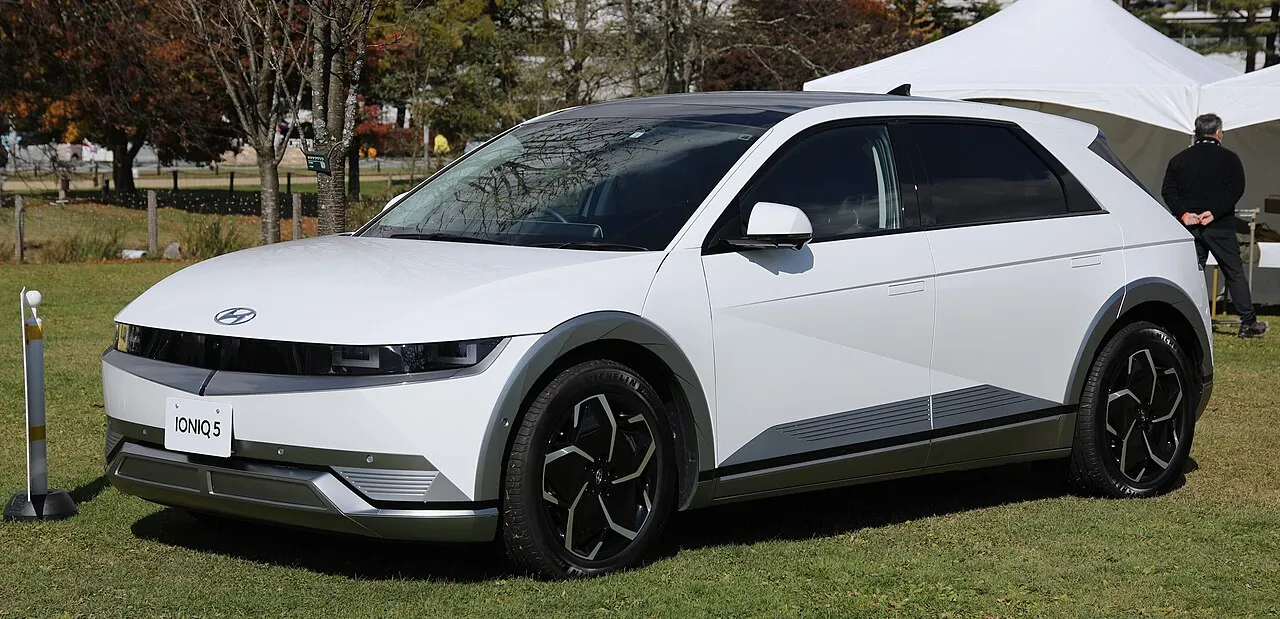
The short answer: The Hyundai IONIQ 5 uses motor windings and inverter switching hardware as a boost converter, raising a lower-voltage DC charger's output to the voltage its battery needs. Charging power still depends on the station's voltage and current limits, the vehicle's conversion limits, and the battery's ability to accept energy.
The Hyundai IONIQ 5 can charge from lower-voltage DC equipment because it uses motor and inverter hardware to raise the incoming voltage before energy reaches the battery. At a 400-volt-class charger, that hardware acts as a boost converter. This expands charging compatibility, but the voltage increase does not create extra power or guarantee the car's highest charging rate.
The distinction matters when choosing a charging stop. A station may connect successfully and deliver energy while remaining unable to support the power the vehicle can accept under more favorable conditions. Understanding that gap requires separating voltage, current, and power—and recognizing that the car's drivetrain hardware has a second job during charging.
Why the battery needs a voltage boost
A DC charger must establish an appropriate voltage to push controlled current into the battery. Battery voltage changes with operating conditions, including state of charge. If a station cannot produce the voltage required at the battery terminals, a direct connection alone cannot sustain charging.
The IONIQ 5 addresses this mismatch through power conversion inside the vehicle. The charger operates within its own output capability, while the car raises that incoming voltage to a suitable level for the battery. The charging equipment and vehicle still coordinate the session, including the voltage and current requested.
The phrase 400-volt charger describes an equipment class rather than a promise that its output stays at exactly that voltage. For compatibility, the station's actual output range matters. Its current limit matters as well, because voltage compatibility by itself says little about how quickly energy can move.
How the motor and inverter become a boost converter
During driving, the traction inverter switches electrical current through the motor windings to produce controlled torque. Those windings also have inductance: they can temporarily store energy in a magnetic field. That property makes them useful for another task when the vehicle is stationary.
During lower-voltage DC charging, the IONIQ 5 uses the motor windings and inverter switching hardware as part of the voltage-boosting circuit. Controlled switching builds current and magnetic energy in the windings, then directs that energy toward the higher-voltage battery circuit. Repeating the process sustains charging at the required battery-side voltage.
This is the operating principle of a boost converter. An inductive element and semiconductor switches transfer energy between circuits operating at different voltages. Reusing traction hardware gives components already needed for propulsion an additional role in charging.
The motor does not need to turn for its windings to perform this electrical function. Energy storage in a winding's magnetic field is distinct from using coordinated motor currents to turn the wheels. Charging control manages the hardware for power conversion while the vehicle remains parked.
Higher voltage does not mean more power
Electrical power depends on both voltage and current. When a converter raises voltage, the available output current decreases relative to the input current for the same transferred power. Conversion also consumes some energy, so battery-side power is lower than the power entering the conversion path.
This explains the central constraint of lower-voltage charging: delivering substantial power at a lower input voltage requires substantial input current. The station, cable, connector, and vehicle charging path each have operating limits. Reaching any relevant limit can prevent charging power from increasing further.
A station's advertised power therefore needs context. Its highest power may be available only within part of its voltage range. If the IONIQ 5 draws from that station at a lower voltage and the station reaches its current ceiling, the resulting power can fall below the prominent rating on the cabinet.
The vehicle's boost function cannot remove that current ceiling. It can make the station's output useful to the battery, but it cannot recover power the station never delivered. The conversion hardware also has its own electrical and thermal limits.
What the published vehicle figures establish
The figures below give selected charging and range context for the IONIQ 5. US figures are credited to US EPA fueleconomy.gov, Canadian figures to Natural Resources Canada, and European figures to EVDB. Each row identifies its market and model year. EPA, NRCan, and WLTP identify the range rating standard; they should not be treated as interchangeable measures.
| Market and model year | Version | Rated range and standard | AC charging figure | Peak DC charging power | Source |
|---|---|---|---|---|---|
| US, 2027 | AWD, 19-inch wheels | 290 miles, EPA | 8.2 hours, Level 2 full charge | Not shown | US EPA fueleconomy.gov |
| US, 2027 | RWD | 318 miles, EPA | 9.1 hours, Level 2 full charge | Not shown | US EPA fueleconomy.gov |
| Canada, 2026 | Long Range | 504 kilometers, NRCan | 8.2 hours, Level 2 full charge | Not shown | Natural Resources Canada |
| Europe, 2026 | Long Range AWD | 498 kilometers, WLTP | 11 kW AC | 240 kW | EVDB |
| Europe, 2026 | Standard Range RWD | 394 kilometers, WLTP | 11 kW AC | 220 kW | EVDB |
The charging columns describe separate capabilities from the range tests. The Level 2 figures concern AC full-charge duration, while the European DC figures describe peak power. Neither establishes a charging rate or session duration on lower-voltage DC equipment.
EVDB's peak DC figures for the European versions should therefore be read as version-specific peaks, not promises for every compatible charger. They also should not be transferred automatically to US or Canadian versions with different market and model-year labels.
Why charging speed changes during a session
Even when a station and the boost circuit can support more power, the battery must be ready to accept it. Battery temperature and state of charge influence the charging request. The vehicle manages that request to keep operation within its battery limits.
As charging progresses, the controlling limit can change. Earlier in a session, station current or conversion capability may be decisive. Later, the battery's requested current may fall. A lower charging rate near a fuller battery does not, by itself, identify a problem with the voltage boost.
Heat also matters because conversion is not lossless. Current flowing through windings and semiconductor devices produces heat, and the vehicle must manage it. The presence of a boost circuit establishes compatibility; it does not imply unlimited continuous operation at any power a station might advertise.
Why this differs from Level 2 charging
Level 2 equipment delivers AC, which the vehicle's onboard charger converts into DC for the battery. A DC fast charger performs AC-to-DC conversion outside the car. The IONIQ 5's voltage-boosting function then addresses a different problem: matching a lower DC supply voltage to the battery's needs.
Consequently, an AC charging power rating or full-charge time does not describe the capability of the motor-and-inverter boost path. These are different operating modes with different limits. The Level 2 durations in the table cannot predict how long a lower-voltage DC stop will take.
What to expect at a lower-voltage station
For a driver, the useful distinction is between successful charging and maximum charging performance. The IONIQ 5's conversion hardware makes lower-voltage DC equipment usable, while actual speed depends on the complete electrical path and the battery's charging request.
When evaluating a station, its output-voltage range and current capability help explain more than its headline power alone. A compatible connector is necessary, but it does not establish those electrical capabilities. Where the station can directly meet the battery's voltage requirement, lower-voltage boosting is unnecessary.
The practical benefit is broader access to DC charging. The practical constraint is that raising voltage cannot increase the energy arriving from the station. The IONIQ 5 can bridge a voltage mismatch; charging speed still follows the limits of the equipment, conversion path, and battery.
Frequently asked questions
How does the Hyundai IONIQ 5 charge from a 400-volt DC charger?
It uses motor windings and inverter switching hardware as a boost converter, raising the incoming DC voltage to the level needed by the battery.
Does boosting voltage increase charging power?
No. Raising voltage reduces the available output current for the same transferred power, and conversion losses consume some energy. The station's voltage and current limits still constrain charging.
Does the motor turn while it helps boost charging voltage?
No motor rotation is needed. The windings perform an electrical role by storing energy in a magnetic field as part of the conversion process.
Can every compatible charger deliver the IONIQ 5's peak DC power?
No. Actual power depends on the station's output range and current limit, the vehicle's conversion capability, and battery conditions. EVDB's peak figures for the European versions do not establish performance at lower-voltage stations.
Do Level 2 charging times predict lower-voltage DC charging speed?
No. Level 2 uses AC and the onboard charger, while lower-voltage DC charging uses a different conversion path. The two modes have different operating limits.
Related stories

Why EV Fast Chargers Reduce Power During a Session
Public fast chargers can lower output when equipment heats up, the site reaches an electrical limit, or protection controls respond. Here is how those limits work.

How to Read EV Charging Connector and Power Labels
Learn how connector names, AC or DC labels, and kilowatt ratings help you choose a compatible EV charging stall and understand its limits.

Why EVs Sometimes Need Separate AC and DC Adapters
AC and DC charging use different paths inside an EV, so an adapter that fits one connector may not support the other. Here’s how compatibility works.