What Separates the Hyundai IONIQ 9 From the Kia EV9?
Compare Hyundai IONIQ 9 and Kia EV9 EPA range and charging times, with clearly labeled European battery, performance and size figures for American buyers.
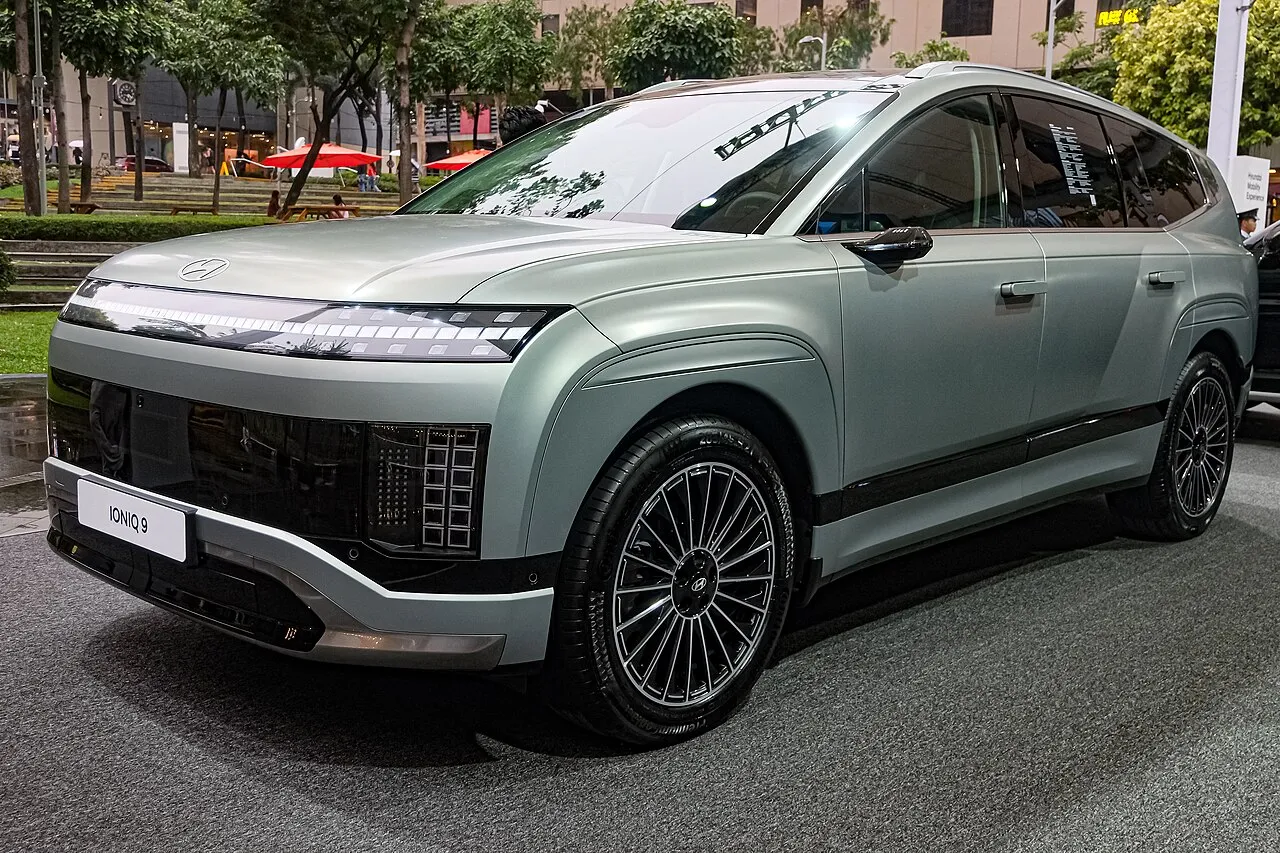
The short answer: The US-market 2027 Hyundai IONIQ 9 leads on EPA range, reaching 335 miles versus 305 miles for the Kia EV9 Long Range RWD. The EV9 has shorter EPA Level 2 full-charge times; European figures add battery, performance and size context, but US starting prices have not been published.
The Hyundai IONIQ 9 is the stronger choice for a US shopper prioritizing rated driving range, while the Kia EV9 has shorter published Level 2 full-charge times. For the US-market 2027 models, EPA ratings put the longest-range Hyundai at 335 miles and the longest-range Kia at 305 miles. The distinction is less clear for battery capacity, fast charging, performance and dimensions: the figures below cover European versions and need to stay attached to those versions. US starting prices have not been published.
US EPA range gives Hyundai the advantage
US EPA fueleconomy.gov rates the 2027 IONIQ 9 RWD at 335 miles, the AWD at 320 miles and the AWD Performance at 311 miles. Kia's 2027 EV9 reaches 305 miles in Long Range RWD form, 283 miles as the Long Range AWD and 280 miles as the Long Range AWD GT-Line. The Standard Range RWD has a 230-mile EPA rating.
That gives Hyundai a 30-mile advantage when comparing the two longest-range rear-wheel-drive versions. Comparing the IONIQ 9 AWD with the EV9 Long Range AWD produces a 37-mile difference. Both comparisons use the same market, model year and EPA standard, making them more useful for an American shopper than comparisons that mix US and overseas range ratings.
The Hyundai range also stays above 300 EPA-rated miles across all three versions. Kia offers a wider span between its shortest- and longest-range versions. An EV9 shopper therefore needs to distinguish Standard Range from Long Range before treating an advertised range figure as relevant to a particular vehicle.
The figures, with markets and standards separated
The table credits US range and Level 2 charging times to US EPA fueleconomy.gov, and European battery, charging, performance and dimensions to EVDB. EPA and WLTP identify range standards; battery capacity, charging power, acceleration and dimensions are separate technical measures. European figures are context for those versions, rather than confirmation of US equipment or performance.
| Vehicle and version | Market and model year | Figure and standard or measurement | Source |
|---|---|---|---|
| IONIQ 9 RWD | US, 2027 | 335 miles, EPA range; 11.7 hours, EPA Level 2 full charge | US EPA fueleconomy.gov |
| IONIQ 9 AWD | US, 2027 | 320 miles, EPA range; 11.6 hours, EPA Level 2 full charge | US EPA fueleconomy.gov |
| IONIQ 9 AWD Performance | US, 2027 | 311 miles, EPA range; 11.5 hours, EPA Level 2 full charge | US EPA fueleconomy.gov |
| EV9 Long Range RWD | US, 2027 | 305 miles, EPA range; 10.7 hours, EPA Level 2 full charge | US EPA fueleconomy.gov |
| EV9 Long Range AWD | US, 2027 | 283 miles, EPA range; 10.7 hours, EPA Level 2 full charge | US EPA fueleconomy.gov |
| EV9 Long Range AWD GT-Line | US, 2027 | 280 miles, EPA range; 10.5 hours, EPA Level 2 full charge | US EPA fueleconomy.gov |
| EV9 Standard Range RWD | US, 2027 | 230 miles, EPA range; 8.1 hours, EPA Level 2 full charge | US EPA fueleconomy.gov |
| IONIQ 9 Long Range RWD | Europe, 2025 | 116 kWh gross and 110.3 kWh usable, NCM battery; 620 km, WLTP range; 11 kW AC and 350 kW peak DC charging | EVDB |
| IONIQ 9 Long Range RWD | Europe, 2025 | 160 kW; 350 Nm; 0–100 km/h in 9.4 seconds; dimensions 5,060 × 1,980 × 1,790 mm; wheelbase 3,130 mm | EVDB; technical figures, not EPA tests |
| IONIQ 9 AWD Performance | Europe, 2025 | 314 kW; 700 Nm; 0–100 km/h in 5.2 seconds; dimensions 5,060 × 1,980 × 1,790 mm; wheelbase 3,130 mm | EVDB; technical figures, not EPA tests |
| EV9 Air RWD | Europe, 2025 | 99.8 kWh gross and usable, NCM battery; 563 km, WLTP range; 11 kW AC and 233 kW peak DC charging | EVDB |
| EV9 Air RWD | Europe, 2025 | 160 kW; 350 Nm; 0–100 km/h in 8.3 seconds; dimensions 5,010 × 1,980 × 1,755 mm; wheelbase 3,100 mm | EVDB; technical figures, not EPA tests |
| EV9 GT AWD | Europe, 2025 | 379 kW; 700 Nm; 0–100 km/h in 4.3 seconds; dimensions 5,015 × 1,980 × 1,755 mm; wheelbase 3,100 mm | EVDB; technical figures, not EPA tests |
| IONIQ 9 and EV9 | US, 2027 | US starting prices have not been published; no price test standard applies | No published US price |
Battery capacity and charging answer different questions
EVDB gives the European 2025 IONIQ 9 Long Range RWD a larger usable battery than the European 2025 EV9 Air RWD: 110.3 kWh against 99.8 kWh. Gross capacity describes the total battery capacity, while usable capacity identifies the portion available for operation. Keeping those measures separate avoids comparing one vehicle's gross figure with another's usable figure.
Those European versions carry WLTP range ratings of 620 km for Hyundai and 563 km for Kia. They form a comparison under that standard, but neither figure should be substituted for a US EPA rating. The European battery figures also should not be attached automatically to the US 2027 versions simply because the vehicle names match.
For US home-charging comparisons, the EPA full-charge times favor Kia. The 2027 EV9 Long Range RWD takes 10.7 hours against 11.7 hours for the IONIQ 9 RWD. The AWD comparison is 10.7 hours for Kia and 11.6 hours for Hyundai. Kia's shortest time, 8.1 hours, belongs to the Standard Range RWD, which also has its shortest EPA range.
A shorter full-charge time does not by itself establish a higher charging-power limit. It describes the time required for that version's full charge, so it needs to be considered alongside how far that version is rated to travel. On these measures, Hyundai offers more EPA range, while Kia completes a full Level 2 charge sooner.
For DC fast charging, EVDB reports a 350 kW peak for the European 2025 IONIQ 9 Long Range RWD and 233 kW for the European 2025 EV9 Air RWD. Both have an 11 kW AC charging rating. Peak DC power is a maximum rather than an average across a charging session, so these figures alone cannot establish a stop's duration. They also do not establish US charging limits.
Performance depends on the version and market
EVDB's European 2025 rear-wheel-drive versions both produce 160 kW and 350 Nm, yet their acceleration figures differ: the IONIQ 9 Long Range RWD reaches 100 km/h in 9.4 seconds, versus 8.3 seconds for the EV9 Air RWD. Equal power and torque therefore do not mean equal acceleration.
At the performance end, EVDB gives the European 2025 IONIQ 9 AWD Performance 314 kW and a 5.2-second 0–100 km/h time. The European 2025 EV9 GT AWD has 379 kW and a 4.3-second time. Both have 700 Nm of torque. This favors the European Kia GT for acceleration, but it does not establish the performance of the US EV9 GT-Line. The different trim names matter, as do the market and model year.
Size and US pricing need separate treatment
The European 2025 dimensions from EVDB make the IONIQ 9 Long Range RWD 50 mm longer and 35 mm taller than the EV9 Air RWD, with a 30 mm longer wheelbase. Both measure 1,980 mm wide. These exterior measurements describe a modest difference in footprint; they do not establish a corresponding advantage in passenger space or cargo capacity.
US starting prices have not been published, so a US purchase-price winner cannot be named. European prices belong to different markets and versions and cannot establish what an American buyer will pay. That leaves price as an unresolved part of this comparison rather than a reason to declare either SUV the better value.
Which buyer suits each SUV?
Choose the IONIQ 9 for the stronger US EPA range ratings. Its RWD version leads this comparison, and its AWD versions retain ratings above 300 miles. That makes Hyundai the clearer fit when rated range is the deciding requirement.
Choose the EV9 if shorter published Level 2 full-charge times better match your priorities. Its Standard Range RWD also offers a distinct option for buyers comfortable with a 230-mile EPA rating. Performance-focused shoppers have a reason to examine the European GT's acceleration figures, while US shoppers should keep those separate from the GT-Line. Neither vehicle can claim the US starting-price advantage until prices are published.
Frequently asked questions
Which has more US EPA range, the Hyundai IONIQ 9 or Kia EV9?
For the US-market 2027 versions, US EPA fueleconomy.gov rates the IONIQ 9 RWD at 335 miles and the EV9 Long Range RWD at 305 miles, giving Hyundai a 30-mile advantage.
Which has the shorter Level 2 full-charge time?
The US-market 2027 Kia EV9 has shorter EPA full-charge times. The Long Range RWD takes 10.7 hours, compared with 11.7 hours for the 2027 IONIQ 9 RWD, according to US EPA fueleconomy.gov.
Does the IONIQ 9 have a bigger battery?
For the European 2025 versions, EVDB gives the IONIQ 9 Long Range RWD 110.3 kWh of usable capacity and the EV9 Air RWD 99.8 kWh. These figures do not establish US battery capacities.
Is the Kia EV9 quicker than the Hyundai IONIQ 9?
EVDB reports a 4.3-second 0–100 km/h time for the European 2025 EV9 GT AWD, compared with 5.2 seconds for the European 2025 IONIQ 9 AWD Performance. This comparison does not establish US GT-Line performance.
Which SUV has the lower US starting price?
US starting prices have not been published, so neither SUV can be identified as the lower-priced US choice.
Related stories

How to Choose an EV for Caregiving and Support Trips
Compare passenger access, rear-seat comfort, equipment storage and charging routines to find an EV that fits recurring appointments and support trips.

Choosing 120V or 240V Charging for an EV at Home
A standard outlet may work for an EV that sits parked for long stretches. A 240V setup adds charging power, which can matter when daily driving uses more energy.

How to Plan EV Charging When You Park on the Street
Street parking can work with EV ownership when you confirm local rules, identify dependable charging, and build a routine that fits where you park.