Hyundai INSTER vs Volvo EX30: Which Fits City Life?
The INSTER takes up less street space, while the EX30 has a longer, wider footprint. Here is what their published dimensions can—and cannot—tell you about room inside.
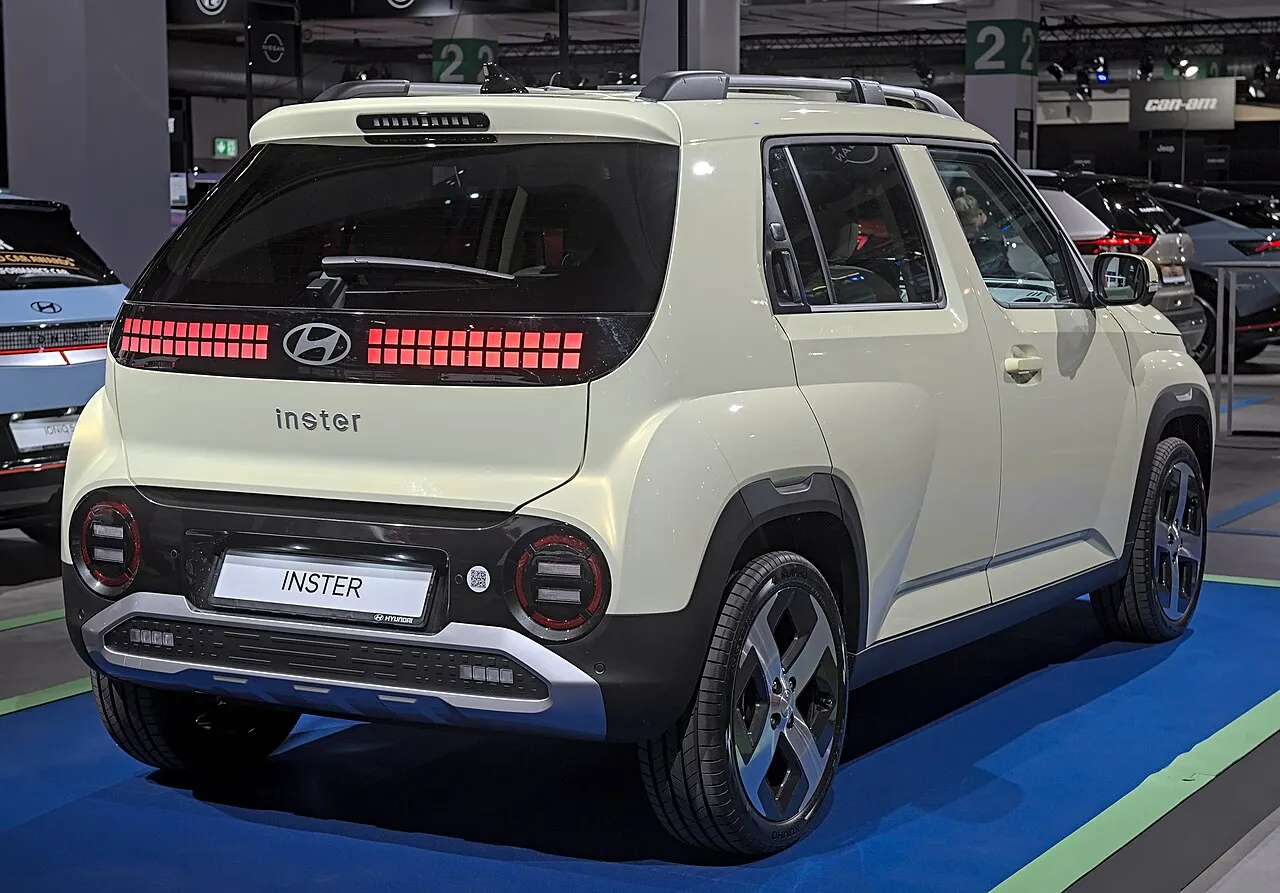
The short answer: The Hyundai INSTER is the smaller vehicle for narrow streets and tight parking. The Volvo EX30 is longer and wider, but published dimensions alone do not establish which has more usable passenger or cargo space.
The Hyundai INSTER is the smaller choice if the immediate concern is fitting a car into a tight urban parking space. For comparable 2025 European versions, EVDB reports that the Volvo EX30 Single Motor is 408 mm longer and 227 mm wider than the INSTER Standard. The EX30 also has a 70 mm longer wheelbase. Those measurements describe the space the vehicles occupy and the distance between their axles; they do not establish how much room passengers or luggage get.
That distinction matters because these are different kinds of small EV. The INSTER is a hatchback, while the EX30 is an SUV. A shopper moving between crowded curbs, narrow entrances and compact garages can use the exterior dimensions to assess fit. A shopper choosing a car for passengers, strollers or bulky bags needs seating and cargo measurements as well. Seating capacity and cargo volume figures have not been published for the versions compared here, so neither vehicle can be declared the roomier one on those measures.
How much space does each EV occupy?
The table uses EVDB figures for 2025 European versions. All figures in the table are physical dimensions, so a driving range test standard such as WLTP or EPA does not apply. The Cross Country column shows how a different EX30 version changes the width and height comparison.
| Exterior measurement | Hyundai INSTER Standard 42 kWh — Europe, 2025; EVDB; physical dimension, no test standard | Volvo EX30 Single Motor — Europe, 2025; EVDB; physical dimension, no test standard | Volvo EX30 Cross Country Twin Motor Performance — Europe, 2025; EVDB; physical dimension, no test standard |
|---|---|---|---|
| Length | 3,825 mm | 4,233 mm | 4,233 mm |
| Width | 1,610 mm | 1,837 mm | 1,850 mm |
| Height | 1,575 mm | 1,550 mm | 1,573 mm |
| Wheelbase | 2,580 mm | 2,650 mm | 2,650 mm |
Length is the clearest starting point for curbside parking or a short garage. The EX30 Single Motor occupies 408 mm more length than the INSTER Standard. That difference can matter when a parking opening leaves little room to pull in or straighten the car. It does not tell you either car’s turning circle or how easily its driver can judge the ends of the body. Those are separate questions from whether the vehicle physically fits.
Width deserves equal attention on streets with closely parked cars. EVDB’s figures put the EX30 Single Motor 227 mm wider than the INSTER Standard. The EX30 Cross Country version in the table is wider still, at 1,850 mm. A narrow space can therefore favor the INSTER even if both cars fit lengthwise. The body width figures do not establish how much space either car needs with its doors open, or whether mirrors must be folded for a particular entrance.
Does the EX30’s longer wheelbase mean more cabin room?
EVDB gives the EX30 versions in the table a 2,650 mm wheelbase, compared with 2,580 mm for the INSTER Standard. Wheelbase is the distance between the axles. A longer one can give designers more room to arrange the cabin, but the measurement does not say where seats are positioned or how much legroom remains behind the front seats. It is a useful clue about vehicle proportions, not a substitute for a passenger space figure.
The same caution applies to the EX30’s extra exterior width. A wider body may create opportunities for a wider cabin, yet the published width alone cannot establish shoulder room or the space available between occupants. Interior trim, doors and seat design all occupy part of the body’s width. Anyone comparing how comfortably the rear seats accommodate passengers needs an interior measurement or a direct check of the seating area.
Height offers another example of why exterior size and usable room should be kept separate. EVDB reports the INSTER Standard at 1,575 mm tall and the EX30 Single Motor at 1,550 mm. The smaller hatchback is therefore taller on the outside in this comparison, despite being shorter and narrower. That does not prove it has more headroom: roof shape, floor height and seat position affect the space available to someone sitting inside.
Version choice also changes the height comparison. EVDB puts the EX30 Cross Country Twin Motor Performance at 1,573 mm tall, close to the INSTER Standard’s 1,575 mm. A statement that the INSTER is substantially taller than every EX30 would miss that variation. For a low garage opening, use the height of the exact version under consideration rather than relying on the vehicle name alone.
What can the dimensions say about cargo?
The EX30’s longer body and wider footprint do not, by themselves, establish a larger trunk. Cargo volume depends on the shape and dimensions of the area behind the seats, the position of those seats and how the available space is measured. A vehicle can devote part of its exterior length to areas other than the luggage compartment. Likewise, the INSTER’s taller exterior does not establish that tall objects will fit through its rear opening.
Cargo volume figures have not been published for the versions in this comparison. That leaves no basis here for a numerical trunk comparison or a claim about how many bags either car holds. It also means the exterior table should not be treated as a ranking of luggage capacity. For a particular stroller, suitcase or other awkward item, opening shape and the room available with the seats in the position you intend to use matter alongside any future volume figure.
Passenger and cargo needs can compete for the same interior space. If a shopping decision depends on carrying rear passengers and luggage at once, a cabin that appears promising from its wheelbase may still need closer examination. The measurements here answer how large each car is outside. They cannot show the amount of usable space left behind occupied seats, or settle whether one layout works better for a particular load.
Which one makes more sense for a city shopper?
Choose the INSTER as the stronger candidate when the limiting factor is the exterior space available on a street or in a garage. Its shorter, narrower body gives it a clear size advantage over the EX30 versions in EVDB’s European figures. The advantage is especially relevant when a space is constrained in both directions: a vehicle must fit within the opening and still leave room for people to get in and out.
Consider the EX30 if a larger exterior footprint is acceptable and you want to investigate whether its different proportions suit your passengers and cargo. Its longer wheelbase and greater width make that investigation reasonable, but they are not proof of an interior advantage. The Single Motor and Cross Country measurements also show why checking the exact version matters when width or height is close to a fixed limit.
For an American reader, these are measurements of European 2025 versions, not a claim about the dimensions of a particular US vehicle. The useful conclusion is straightforward: the INSTER is smaller outside; the EX30 takes up more length and width. Seating and cargo space remain open questions until figures for the relevant versions, or the vehicles themselves, can be checked.
Frequently asked questions
Which is shorter, the Hyundai INSTER or Volvo EX30?
EVDB reports the 2025 European INSTER Standard at 3,825 mm long and the 2025 European EX30 Single Motor at 4,233 mm long. These are physical dimensions, so no range test standard applies.
Is the INSTER narrower than the EX30?
Yes. For 2025 European versions, EVDB reports widths of 1,610 mm for the INSTER Standard and 1,837 mm for the EX30 Single Motor. These are physical dimensions, with no test standard applicable.
Does the Volvo EX30 have more cargo room?
Cargo volume figures have not been published for the versions compared here. The EX30’s greater exterior length and width do not establish its usable cargo space.
Which vehicle is taller?
In EVDB’s 2025 European physical dimensions, the INSTER Standard is 1,575 mm tall, the EX30 Single Motor is 1,550 mm tall, and the EX30 Cross Country Twin Motor Performance is 1,573 mm tall. No range test standard applies to these measurements.
Related stories

How to Choose an EV for Caregiving and Support Trips
Compare passenger access, rear-seat comfort, equipment storage and charging routines to find an EV that fits recurring appointments and support trips.

How to Choose an EV for Your Dog and Travel Gear
Compare an EV’s entry points, secure travel area, climate controls and cleanability with your dog and gear on hand before choosing a vehicle.
Kia EV3 vs. BYD ATTO 3: Which SUV Fits Daily Life?
The Kia EV3 and BYD ATTO 3 suit different daily needs. Compare market-specific range figures, dimensions and charging, then check cargo access and fit in person.