Electric James Bond Car Picks Span Tesla, Volvo and Lotus
EV Powered’s electric James Bond car picks range from Tesla and Volvo sedans to a converted Land Rover, pairing familiar badges with modern EV technology.
The short answer: EV Powered has proposed electric cars for James Bond, including the Tesla Model 3 Performance, Volvo ES90, Polestar 5 and Lotus Emeya. These are editorial suggestions, rather than an announced vehicle selection for a Bond film.
Electric sedans, sports cars and a converted Land Rover feature in EV Powered’s proposed vehicle lineup for James Bond, bringing an electric twist to a franchise associated with Aston Martin, Lotus and elaborate automotive gadgets. For EV buyers, the selections connect that screen history with actual choices involving performance, battery capacity, charging and driving range.
The feature follows what EV Powered describes as MGM’s announcement that Robert Pattinson would play 007. Its vehicle choices are editorial proposals, however, and do not establish which cars will appear in a film. The distinction matters particularly where the feature imagines weapons, flying hardware and other fictional modifications to production EVs.
Among the candidates, the Tesla Model 3 and Volvo ES90 offer a useful connection to published market-specific figures. Other suggestions emphasize Bond’s history with particular brands, from the Lotus Esprit to the BMW 750iL, while an electric Land Rover conversion preserves a connection to his older off-road vehicles.
Polestar and Lotus lead the performance proposals
EV Powered puts the Polestar 5 forward as an alternative to Bond’s traditional Aston Martin. The outlet says Aston Martin’s electric E-Rapide did not reach production, removing what it considers a natural candidate. Its Polestar argument combines styling, technology and performance: it reports an 871-bhp all-wheel-drive powertrain and suspension that scans the road and reacts 1,000 times a second.
The Polestar’s blanked-out rear window also gives the outlet a visual connection to the defensive shield on Bond’s Aston Martin DB5. That is a styling analogy, rather than a claim that the electric car has comparable protective equipment. The proposal rests on the idea that a contemporary electric car can evoke Bond’s gadget-heavy vehicles through its existing design.
Lotus offers a more direct historical link. EV Powered proposes the Emeya as a modern electric successor to the Esprit associated with Bond. According to the outlet, the most powerful Emeya has nearly 900 bhp and accelerates from 0 to 62 mph in less than three seconds. It contrasts that output with the 210 bhp of Bond’s 1981 Turbo Esprit.
Those figures explain the Emeya’s place in the feature without requiring fictional upgrades. The connection is both mechanical and cinematic: the Lotus name returns, while electric propulsion changes the type of car carrying it. EV Powered’s suggestion of fitting lasers into the headlights remains part of the fantasy.
Volvo ES90 brings performance and battery choices
The Volvo ES90 is another Swedish candidate. EV Powered describes a twin-motor, 670-bhp ES90 as a suitable vehicle for Bond and highlights its computing technology. The outlet also connects the suggestion to the Saab 900 Turbo used by Bond in John Gardner’s novels, extending the discussion beyond cars seen on screen.
For buyers, the European-market 2026 ES90 range has three distinct versions. According to EVDB, the Single Motor produces 245 kW, drives the rear wheels and reaches 100 km/h from rest in 6.6 seconds. Its battery has 92 kWh of gross capacity and 88 kWh of usable capacity, with a European WLTP-rated range of 651 kilometers.
EVDB puts the European Twin Motor at 335 kW and 670 Nm, with all-wheel drive and a 5.5-second 0–100 km/h time. The Twin Motor Performance raises output to 500 kW and torque to 870 Nm, cutting that acceleration time to four seconds. Both versions have a 106-kWh gross battery, 102 kWh of usable capacity and a 700-kilometer WLTP rating.
Charging capability also differs by version. EVDB reports peak DC charging of 310 kW for the European Single Motor and 350 kW for the two all-wheel-drive versions, with 11-kW AC charging across the range. Those are charging-power figures; they do not establish how long a complete charging session will take.
The ES90’s size gives the proposal a different character from a compact sports car. EVDB puts all three European versions at 5,000 millimeters long, with a 3,102-millimeter wheelbase. The performance model therefore combines its four-second acceleration figure with the same exterior dimensions as the less powerful versions.
Tesla’s candidate has a US range reference
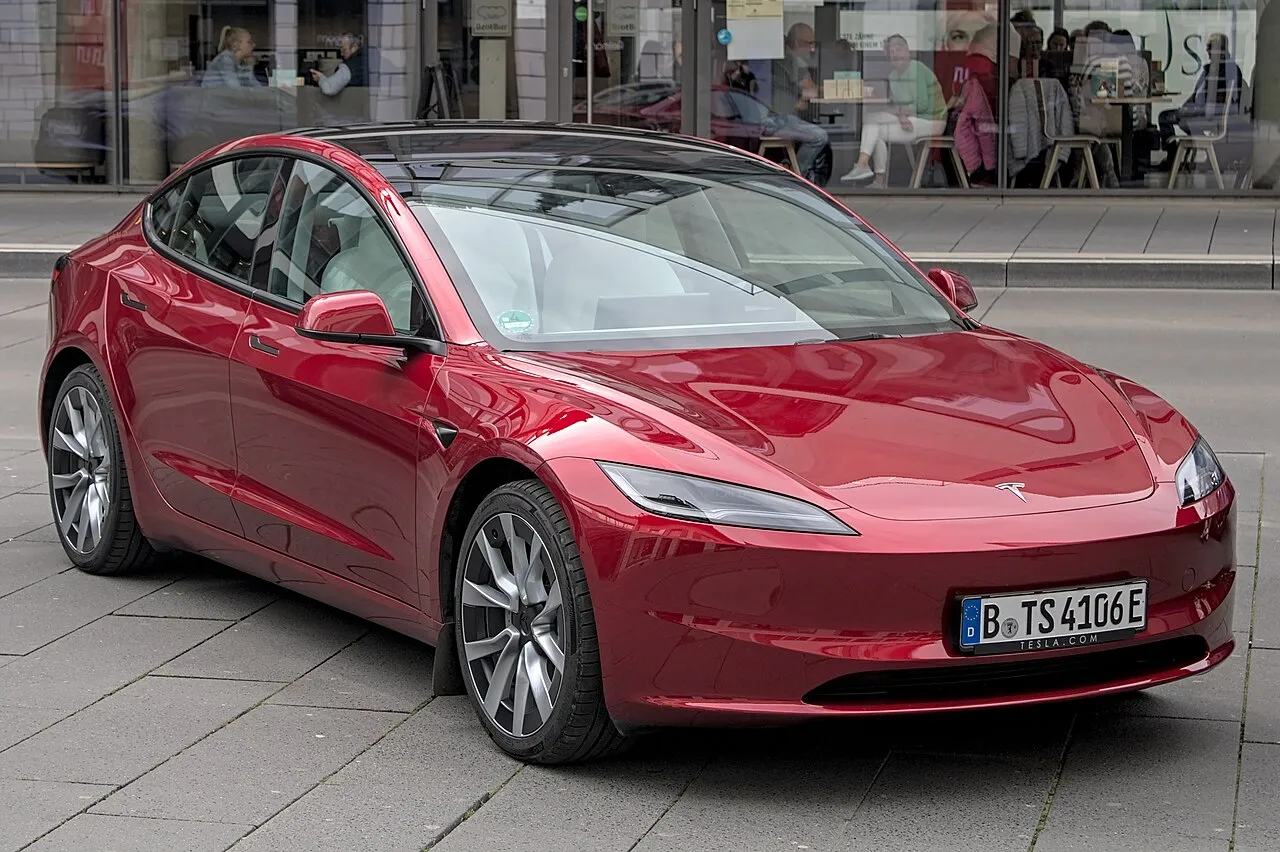
EV Powered also nominates the Tesla Model 3 Performance, citing the car’s technology and relatively anonymous appearance as reasons it could suit covert work. Its imagined wings and self-destruct function are fictional embellishments. The actual Model 3 figures offer a more concrete basis for understanding the car behind the proposal.
For the US-market 2027 Model 3 Performance AWD, EPA ratings give a driving range of 316 miles and a full Level 2 charging time of 12 hours. These figures apply to that American version and model year. They should not be treated as ratings for every Model 3 sold in other markets.
The other US-market 2027 versions show how the Performance fits within the range. EPA ratings put the Premium AWD at 346 miles, the Premium RWD at 363 miles and the RWD at 321 miles. The Performance therefore has the shortest EPA-rated range among those four versions, while retaining the all-wheel-drive configuration identified in its name.
European figures describe different versions under a different test standard. According to EVDB, the European-market 2026 Model 3 Premium AWD has a 691-kilometer WLTP range, while the Premium RWD is rated at 750 kilometers WLTP. Both have 82-kWh gross batteries and 79 kWh of usable capacity. Those WLTP results are separate from the American EPA ratings and do not establish a direct range advantage over the US Performance.
Electric conversions and sports cars preserve older links
Not every proposed Bond EV is a modern sedan. EV Powered points to Inverted’s electric Land Rover conversion as a way to retain the character of the Series III driven by Bond in No Time to Die. According to the outlet, the conversion replaces a 2.5-liter gasoline engine with a 160-bhp electric motor producing 644 lb-ft of torque.
The motor remains connected to the original transfer case, which EV Powered says preserves the vehicle’s off-road ability. A 62-kWh battery accompanies a claimed range of 160 miles. The report does not identify a range test standard, so that figure cannot support a like-for-like comparison with the Tesla’s EPA ratings or Volvo’s WLTP results.
For a more traditional sports-car role, the outlet proposes the British-built Longbow Speedster and Roadster. EV Powered credits them with lightweight construction, a claimed 275-mile range and a 0–62 mph time below four seconds. Here, too, the range claim has no named test standard. Their relevance to the feature is the combination of electric propulsion and the two-door format associated with many Bond cars.
BMW and Audi extend the franchise connections
EV Powered’s BMW suggestion is the i7, recalling the 750iL in Tomorrow Never Dies. The outlet reports 537 bhp and points to the armored Protection variant. It also notes remote parking, creating a limited real-world connection to the earlier film car’s remote-control capability.
The Audi S6 Avant supplies a wagon alternative. According to EV Powered, it produces 543 bhp and uses Quattro all-wheel drive. The outlet links it to the Audi 200 Quattro Avant driven by Timothy Dalton’s Bond in The Living Daylights, giving another electric proposal a connection to the franchise’s existing vehicle history.
What happens next for Bond’s actual screen transport remains unresolved: EV Powered’s feature establishes a set of suggestions, without announcing an automotive partnership or film vehicle. Its candidates nevertheless demonstrate the breadth of electric cars available to inspire that choice, from a converted classic to high-output sedans, a wagon and lightweight sports cars.
Frequently asked questions
Has an electric car been selected for the next James Bond film?
EV Powered’s feature proposes possible electric Bond cars. It does not announce a vehicle selection or automotive partnership for a film.
Which Tesla does EV Powered suggest for James Bond?
The outlet suggests the Tesla Model 3 Performance. The US-market 2027 Performance AWD has an EPA-rated range of 316 miles.
What is the Volvo ES90’s European range?
According to EVDB, the European-market 2026 ES90 Single Motor has a 651-kilometer WLTP rating. The Twin Motor and Twin Motor Performance each have a 700-kilometer WLTP rating.
Why does the Lotus Emeya appear among the proposals?
EV Powered connects the Emeya to Bond’s history with the Lotus Esprit. The outlet reports nearly 900 bhp and a 0–62 mph time below three seconds for the most powerful Emeya.
What powers the proposed electric Land Rover conversion?
According to EV Powered, Inverted’s conversion uses a 160-bhp electric motor with 644 lb-ft of torque and a 62-kWh battery, while retaining the original transfer case.
Related stories

BMW Targets 625 kW for Its Four-Motor Electric M3
BMW says its electric M3 is targeting 625 kW, four independently controlled motors and about 650 km of range, while a gasoline M3 remains in development.
West Coast Customs Builds a Bel Air on a Tesla Model 3
West Coast Customs put a 1955 Chevy Bel Air body over a Tesla Model 3 platform, retaining the Tesla cabin, electric drivetrain and Supercharger access.

BMW M3 EV Set for Four Motors and 838 Horsepower
BMW’s electric M3 is expected to enter production in 2027 with four motors, an 800-volt architecture and a gasoline-powered sibling sold alongside it.