Rear-Seat Space in the Volkswagen ID.7 and Hyundai IONIQ 6
The ID.7 is taller, but exterior size cannot settle rear-seat comfort. Compare the dimensions and what matters when adults travel with luggage.
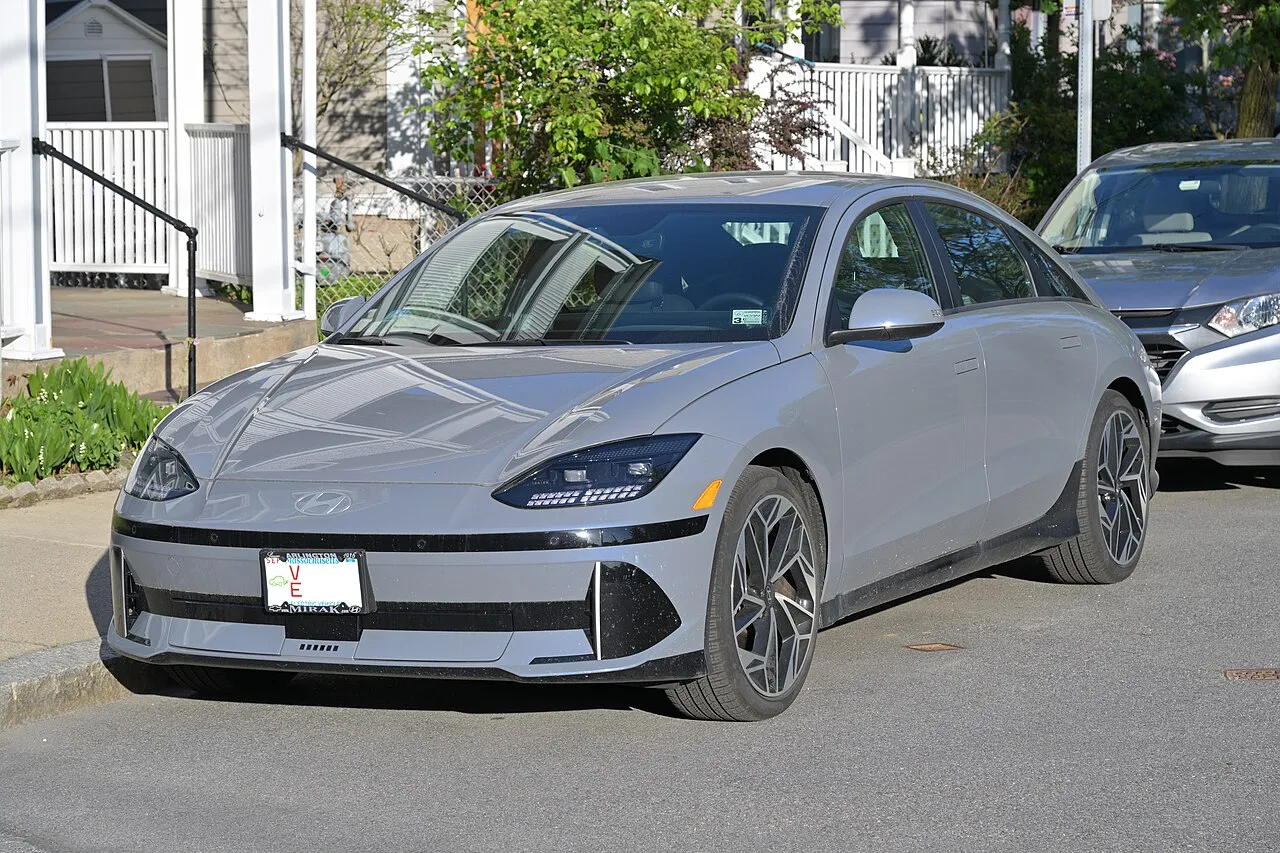
The short answer: The Volkswagen ID.7 has a taller exterior than the Hyundai IONIQ 6 versions compared here, making it worth considering for adult passengers, but that does not establish better rear-seat comfort. Rear headroom, legroom and cargo-opening measurements have not been published by the sources cited here, so a firm passenger-space or luggage-access winner cannot be named.
The Volkswagen ID.7 has the taller exterior, but the figures available from EVDB and OpenEV Data do not establish which car gives adults a more comfortable rear seat or makes luggage easier to load. The ID.7 deserves consideration if passenger accommodation is the priority; its extra exterior height is a useful clue, rather than proof of extra headroom. Cargo capacity and opening measurements have not been published by these sources, leaving luggage access unresolved.
For shoppers who regularly carry adults, the distinction matters. Overall length, height and wheelbase describe the vehicle around its occupants. They do not measure the room between a passenger’s head and the roof, the support beneath their thighs or the opening through which a suitcase must pass. Those are separate questions, and a favorable exterior dimension cannot answer all of them.
How the exterior dimensions compare
A useful starting point is the European-market comparison between the Volkswagen ID.7 Pro S and Hyundai IONIQ 6 84 kWh RWD, both for model year 2026. EVDB attributes a taller and slightly longer body to the Volkswagen, while the Hyundai is slightly wider. The American-market 2025 IONIQ 6 Long Range adds another relevant reference: OpenEV Data records a shorter overall length than the European Hyundai, with the same height, width and wheelbase.
| Vehicle and version | Market and model year | Length | Width | Height | Wheelbase | Dimensional test standard | Source |
|---|---|---|---|---|---|---|---|
| Volkswagen ID.7 Pro S | Europe, 2026 | 4,961 mm | 1,862 mm | 1,536 mm | 2,966 mm | Not published by the source | EVDB |
| Hyundai IONIQ 6 84 kWh RWD | Europe, 2026 | 4,925 mm | 1,880 mm | 1,495 mm | 2,950 mm | Not published by the source | EVDB |
| Hyundai IONIQ 6 Long Range | US, 2025 | 4,855 mm | 1,880 mm | 1,495 mm | 2,950 mm | Not published by the source | OpenEV Data |
All dimensions in the table are in millimeters. EPA and WLTP are range test standards, not interior-space or cargo-access measurements, and neither establishes how these exterior dimensions translate into usable room. The market and model-year labels also matter: the European Hyundai’s greater overall length should not be treated as evidence that the American version has the same body dimensions.
What the taller ID.7 does—and does not—tell you
The Volkswagen’s greater exterior height is the clearest dimensional reason to investigate it for adult passengers. A taller body can give designers more vertical space to work with. However, rear headroom also depends on the floor, seat cushion, roof lining and the roof’s shape above the passenger. Overall height measures the outside of the car, rather than the space available above a seated adult.
That means the ID.7’s height advantage supports a cautious shortlist decision, not a comfort verdict. An adult with a long torso may care most about clearance above the seat. Another passenger may be more sensitive to the height of the cushion relative to the floor. A car can accommodate someone’s head while leaving their knees raised or their thighs poorly supported.
The IONIQ 6’s lower exterior height likewise does not prove that its rear seat is unsuitable for adults. Seat positioning can change how effectively the available space is used. Without comparable interior measurements, neither the Volkswagen’s taller body nor the Hyundai’s lower body establishes the seating posture an adult will actually have.
Wheelbase is a clue, not a legroom measurement
EVDB records a slightly longer wheelbase for the European ID.7 Pro S than for the European IONIQ 6 84 kWh RWD. Wheelbase is the distance between the axles. It helps describe the vehicle’s proportions, but it does not show how much of the cabin is allocated to rear passengers or where the front seatbacks sit.
Rear legroom changes with the front occupants’ seating positions. Seatback thickness, cushion shape and the space available for feet also affect whether a passenger can settle into a natural posture. A wheelbase comparison cannot resolve those details, particularly when the difference is modest and the seating layouts have not been measured on a common basis.
The Hyundai comparison illustrates another limitation. OpenEV Data and EVDB record the same wheelbase for the American and European versions in the table, despite their different overall lengths. The extra body length therefore cannot simply be read as extra distance between the axles. It also cannot be assigned to passenger space or luggage space without further measurements.
Adult comfort involves more than knees and headroom
For regular adult passengers, the useful question is whether the rear seat supports a relaxed posture with the front seats set for their usual occupants. Knee clearance is part of that assessment, but so are foot space, thigh support and the seatback angle. A passenger who fits only by moving their feet awkwardly may find the seat less comfortable over a longer journey.
Entry and exit deserve separate attention. Exterior roof height does not describe the rear door opening, the clearance past the roof edge or the movement needed to sit down. Someone can have adequate room once seated yet find getting into that position inconvenient. Neither source publishes door-opening dimensions that would establish an advantage for either car.
Width requires similar care. The Hyundai’s greater exterior width does not establish greater rear shoulder room. Exterior body width and usable interior width are different measurements, and seat contour affects how occupants share the available space. For a household that regularly fills the rear bench, outer dimensions alone are an especially incomplete guide.
Cargo volume and loading access are separate questions
Neither EVDB nor OpenEV Data publishes cargo capacity or cargo-opening measurements for these versions in the information compared here. Consequently, there is no supported basis for declaring that either car holds more luggage, accepts a larger suitcase or offers easier loading. The Volkswagen’s greater overall length does not settle any of those questions.
Cargo volume describes an amount of space; access describes whether an object can pass through the opening and reach that space. A broad suitcase may be constrained by an opening even when there is room farther inside. A long object may fit the compartment but require an awkward angle during loading. These practical differences cannot be inferred from exterior length and width.
The relevant load is also the luggage carried with the adult passengers still seated. Any arrangement that requires occupying passenger space changes the usefulness of the car for this particular task. A meaningful comparison therefore needs to preserve the seating arrangement used on normal trips and establish whether the intended bags fit in the remaining luggage area.
Which belongs on an adult-passenger shortlist?
The ID.7’s taller exterior and slightly longer wheelbase give shoppers a reasonable basis to investigate its rear-seat accommodation first. Those dimensions do not support calling it the more comfortable car outright. The IONIQ 6 remains a candidate because its lower exterior height does not reveal its actual headroom, seating posture or ease of entry.
The decisive comparison is passenger fit followed by luggage access with those passengers accommodated. For the exact market, model year and version under consideration, assess the rear seat behind the usual front-seat positions and check the intended bags through the actual cargo opening. Until comparable interior and cargo measurements are available, the defensible conclusion is a dimensional advantage for the Volkswagen in height, with rear-seat comfort and luggage usability still requiring direct verification.
Frequently asked questions
Is the Volkswagen ID.7 taller than the Hyundai IONIQ 6?
Yes, for the versions compared here. EVDB records a height of 1,536 mm for the European-market 2026 ID.7 Pro S and 1,495 mm for the European-market 2026 IONIQ 6 84 kWh RWD. These are exterior dimensions; the source does not publish their dimensional test standard.
Does the ID.7 have more rear legroom?
A rear-legroom advantage cannot be established from the published exterior dimensions. EVDB records a slightly longer wheelbase for the European 2026 ID.7 Pro S than for the European 2026 IONIQ 6 84 kWh RWD, but wheelbase does not measure passenger legroom.
Which car has better luggage access?
Cargo-opening measurements have not been published by the sources cited here for these versions. Exterior dimensions alone cannot establish which car makes luggage easier to load.
Are the American and European IONIQ 6 dimensions identical?
Not for the versions compared here. OpenEV Data records a shorter overall length for the US-market 2025 Long Range than EVDB records for the European-market 2026 84 kWh RWD. Their recorded width, height and wheelbase are the same.
Related stories

How to Choose an EV for Your Dog and Travel Gear
Compare an EV’s entry points, secure travel area, climate controls and cleanability with your dog and gear on hand before choosing a vehicle.
Kia EV3 vs. BYD ATTO 3: Which SUV Fits Daily Life?
The Kia EV3 and BYD ATTO 3 suit different daily needs. Compare market-specific range figures, dimensions and charging, then check cargo access and fit in person.

How to Choose an EV for Frequent Rural Errands
Compare cargo space, ground clearance, charging access and a realistic range buffer to find an EV that can handle your regular rural trips.