Kia EV9 vs Volkswagen ID.4: Price and Practical Differences
Compare the Kia EV9 and Volkswagen ID.4 on US EPA range, charging, battery size and price, with clear distinctions for European performance and size figures.
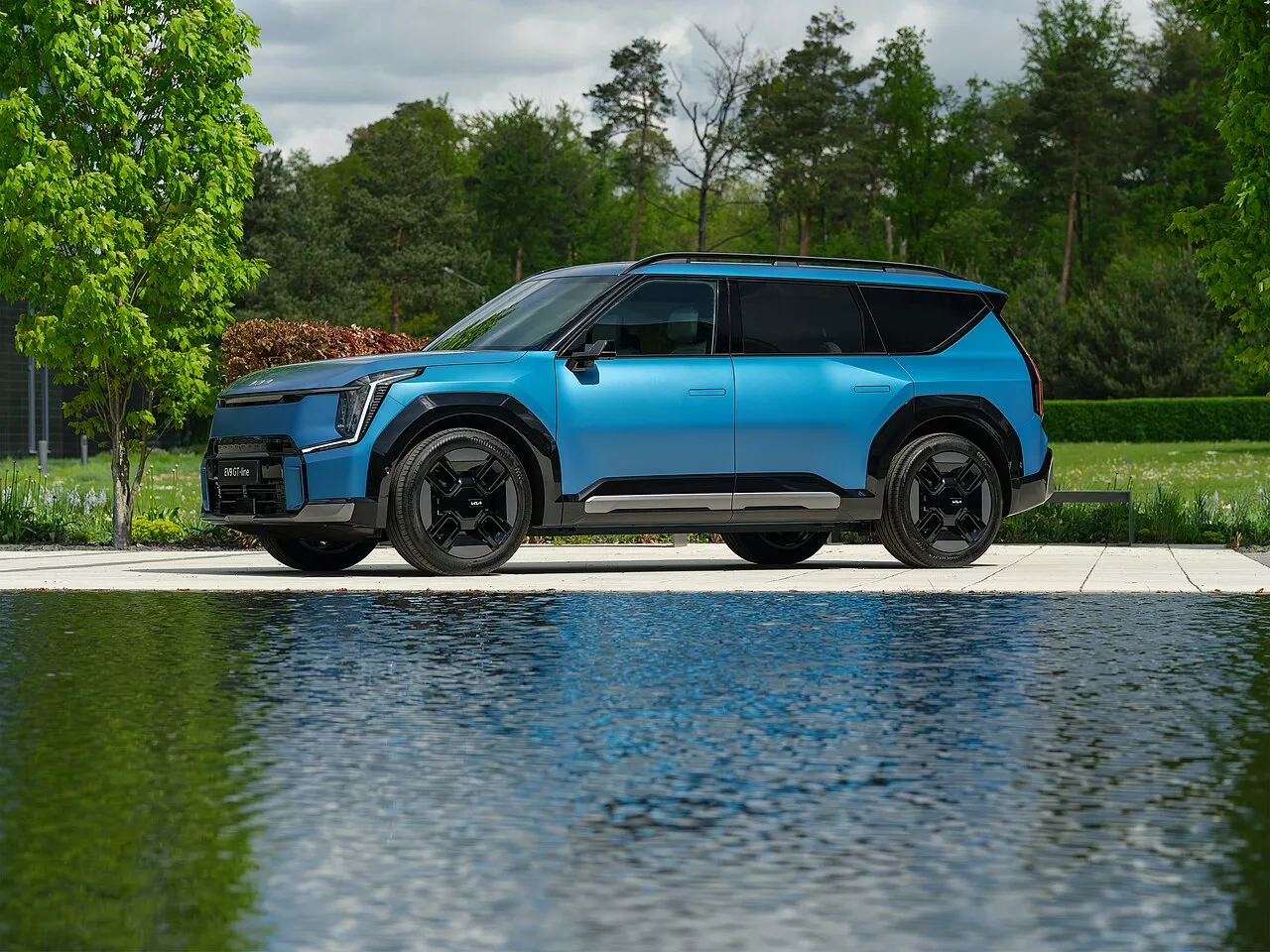
The short answer: The Kia EV9 suits buyers prioritizing a larger SUV and the longest US EPA range here, while the Volkswagen ID.4 suits buyers seeking a smaller vehicle with shorter EPA Level 2 charging times. The ID.4 has a documented US starting price of $45,095; an equivalent US starting price for the EV9 has not been published.
The Kia EV9 is the stronger candidate if a larger SUV and maximum EPA-rated range lead your priorities. The Volkswagen ID.4 makes more sense if you favor a smaller footprint and shorter Level 2 charging times. Price cannot settle the comparison completely: the US-market 2026 ID.4 starts at $45,095 in the price entry dated November 2026, while a US starting price for the EV9 has not been published.
The comparison also spans different model years. US EPA fueleconomy.gov rates the US 2027 EV9 Long Range RWD at 305 miles and the US 2026 ID.4 RWD at 291 miles. Battery capacities, peak DC charging rates, acceleration and dimensions below refer to European 2025 versions. Those figures help explain the vehicles’ differences, but they do not establish identical capabilities for their American counterparts.
Kia EV9 and Volkswagen ID.4 at a glance
The table separates US EPA ratings from European technical figures. EPA applies to the American range and Level 2 charging entries. For European technical figures, the relevant quantity or acceleration interval is identified; a separate test protocol has not been published.
| Measure and basis | Kia EV9 | Volkswagen ID.4 |
|---|---|---|
| US rated range, EPA | 2027: Long Range RWD, 305 miles; Long Range AWD, 283 miles; Long Range AWD GT-Line, 280 miles; Standard Range RWD, 230 miles. Source: US EPA fueleconomy.gov. | 2026: RWD, 291 miles; AWD, 263 miles. Source: US EPA fueleconomy.gov. |
| US Level 2 full-charge time, EPA entry | 2027: Long Range RWD and Long Range AWD, 10.7 hours; Long Range AWD GT-Line, 10.5 hours; Standard Range RWD, 8.1 hours. Source: US EPA fueleconomy.gov. | 2026: RWD and AWD, 8 hours. Source: US EPA fueleconomy.gov. |
| US starting price; price, not a test result | US starting price has not been published. | 2026 RWD: $45,095, as of November 2026, accompanying the US EPA fueleconomy.gov entry. |
| European battery capacity; gross/usable, separate test protocol unpublished | 2025 Air RWD and GT AWD: 99.8/99.8 kWh, NCM chemistry. Source: EVDB. | 2025 Pro, GTX and Pro 4Motion: 82/77 kWh, NCM chemistry. Sources: OpenEV Data and EVDB for Pro and GTX; EVDB for Pro 4Motion. |
| European AC and peak DC charging; separate test protocol unpublished | 2025 Air RWD and GT AWD: 11 kW AC; 233 kW peak DC. Source: EVDB. | 2025 Pro and GTX: 11 kW AC; 135 kW peak DC. Sources: OpenEV Data and EVDB. Pro 4Motion: 11 kW AC; 175 kW peak DC. Source: EVDB. |
| European power and acceleration; 0–100 km/h interval, separate test protocol unpublished | 2025 Air RWD: 160 kW, 8.3 seconds. GT AWD: 379 kW, 4.3 seconds. Source: EVDB. | 2025 Pro: 150 kW, 8.5 seconds. GTX: 220 kW, 6.2 seconds. Sources: OpenEV Data and EVDB. Pro 4Motion: 250 kW, 6.2 seconds. Source: EVDB. |
| European exterior dimensions; length × width × height, separate measurement protocol unpublished | 2025 Air RWD: 5,010 × 1,980 × 1,755 mm. Source: EVDB. | 2025 Pro: 4,584 × 1,852 × 1,642 mm. Sources: OpenEV Data and EVDB. |
EPA range depends on the version you choose
The EV9’s range advantage belongs to its Long Range versions. The US 2027 Long Range RWD reaches 305 miles under EPA ratings, 14 miles beyond the US 2026 ID.4 RWD’s 291 miles. That makes the rear-wheel-drive Kia the range leader in this comparison, but the margin is modest enough that choosing the correct trim matters more than choosing by badge alone.
The same pattern holds for the American all-wheel-drive versions. EPA ratings put the 2027 EV9 Long Range AWD at 283 miles and its GT-Line counterpart at 280 miles, versus 263 miles for the 2026 ID.4 AWD. Both Kias therefore retain a range advantage over the Volkswagen when comparing AWD with AWD.
The picture changes with the EV9 Standard Range RWD. Its US 2027 EPA rating is 230 miles, below both American ID.4 versions. A shopper comparing an entry EV9 with an ID.4 should therefore avoid assuming that the larger Kia automatically travels farther between charges. The EV9 name covers a substantial spread of rated range.
These are EPA-to-EPA comparisons, although the model years differ. European WLTP or Canadian NRCan range ratings should not be substituted into this ranking. Keeping the American ratings together gives a US shopper a consistent test-standard basis without suggesting that different regional procedures produce interchangeable results.
Battery capacity and charging tell different stories
EVDB gives the European 2025 EV9 Air RWD and GT AWD a 99.8-kWh battery, with both gross and usable capacity recorded at that figure. For the European 2025 ID.4 versions, OpenEV Data and EVDB report an 82-kWh gross battery with 77 kWh usable. Both vehicles use NCM chemistry in these European configurations.
The distinction between gross and usable capacity matters when reading the comparison: one describes the total battery capacity, while the other describes the usable amount. The European Kia has the larger usable capacity here. Those European capacities should nevertheless remain separate from conclusions about the American versions, whose battery capacities have not been published.
For home charging, the American EPA entries offer a more directly relevant comparison. Both US 2026 ID.4 versions have an eight-hour Level 2 full-charge figure. The US 2027 EV9 Long Range RWD and AWD each take 10.7 hours, while the Long Range AWD GT-Line takes 10.5 hours. The Standard Range RWD is much closer to the Volkswagen at 8.1 hours.
These full-charge durations describe a different aspect of charging from a peak power rating. They support the conclusion that the ID.4 has the shorter EPA Level 2 full-charge time, but do not establish how much energy either vehicle adds during a particular shorter charging session.
For DC charging, the European figures favor the Kia on peak power. EVDB reports 233 kW for the 2025 EV9 Air RWD and GT AWD. The European 2025 ID.4 Pro and GTX reach 135 kW according to OpenEV Data and EVDB, while EVDB records 175 kW for the Pro 4Motion. All these European versions have an 11-kW AC rating.
A peak DC figure alone cannot establish the duration of a charging stop. Comparable DC charging-window times have not been published, so the higher European EV9 peak does not justify a precise claim about minutes saved. It also should not be presented as a verified US charging rating.
Performance and size: the European comparison
The European acceleration figures show why trim selection matters here, too. EVDB records 8.3 seconds from 0–100 km/h for the 2025 EV9 Air RWD. OpenEV Data and EVDB record 8.5 seconds for the European 2025 ID.4 Pro. These particular rear-wheel-drive versions are close on that acceleration measure.
The European EV9 GT AWD is a different proposition: EVDB records 379 kW and a 4.3-second 0–100 km/h time. The European ID.4 GTX has 220 kW and a 6.2-second time, while the Pro 4Motion has 250 kW and the same acceleration time. These are European trim comparisons, and the interval is 0–100 km/h; they are not US 0–60 mph results.
Size creates a clearer distinction between the vehicles. The European 2025 EV9 Air RWD measures 5,010 mm long and 1,980 mm wide, according to EVDB. The European 2025 ID.4 Pro measures 4,584 mm long and 1,852 mm wide, according to OpenEV Data and EVDB. The Kia therefore occupies a noticeably larger exterior footprint.
That favors the Volkswagen for a buyer prioritizing exterior compactness, while the Kia suits someone deliberately seeking a larger SUV. Exterior dimensions alone do not establish passenger or cargo capacity, so they cannot settle a detailed interior-space comparison.
Price and which buyer each SUV suits
The US 2026 ID.4 RWD’s $45,095 starting figure is dated November 2026 and accompanies its US EPA fueleconomy.gov entry. A US starting price for the EV9 has not been published. That prevents a defensible dollar-for-dollar judgment about which vehicle offers better value; European prices would not resolve the American purchase-price question.
Choose the EV9 Long Range if your priorities are the larger vehicle and the highest US EPA range in this comparison. Choose the ID.4 if you prefer the smaller European exterior dimensions, shorter US EPA Level 2 full-charge times and an established US starting-price reference. For either vehicle, match the exact drivetrain and trim to your priorities: the range and performance conclusions change substantially across versions.
Frequently asked questions
Which has more US EPA range, the Kia EV9 or Volkswagen ID.4?
The US 2027 Kia EV9 Long Range RWD has a 305-mile EPA rating, compared with 291 miles for the US 2026 Volkswagen ID.4 RWD. The EV9 Standard Range RWD has a lower 230-mile EPA rating.
Which has the shorter Level 2 full-charge time?
US EPA fueleconomy.gov records eight hours for both US 2026 ID.4 drivetrains. US 2027 EV9 figures range from 8.1 hours for Standard Range RWD to 10.7 hours for Long Range RWD and Long Range AWD.
What are their US starting prices?
The US 2026 ID.4 RWD has a $45,095 starting-price entry dated November 2026, accompanying its US EPA fueleconomy.gov entry. A US starting price for the EV9 has not been published.
Does the EV9 have a higher peak DC charging rate?
For European 2025 versions, EVDB reports 233 kW for the EV9 Air RWD and GT AWD. European ID.4 figures are 135 kW for Pro and GTX, according to OpenEV Data and EVDB, and 175 kW for Pro 4Motion, according to EVDB. These are European peak ratings, not verified US charging figures.
Related stories

How to Choose an EV for Caregiving and Support Trips
Compare passenger access, rear-seat comfort, equipment storage and charging routines to find an EV that fits recurring appointments and support trips.

Choosing 120V or 240V Charging for an EV at Home
A standard outlet may work for an EV that sits parked for long stretches. A 240V setup adds charging power, which can matter when daily driving uses more energy.

How to Plan EV Charging When You Park on the Street
Street parking can work with EV ownership when you confirm local rules, identify dependable charging, and build a routine that fits where you park.