Hyundai Looks to China for Cheaper Small EVs in Australia
Hyundai is considering China-developed electric hatchbacks and SUVs for Australia as it seeks lower entry prices amid growing competition from Chinese brands.
The short answer: Hyundai is considering China-developed small electric hatchbacks and SUVs to make its Australian EV range more affordable, according to EV Central. No models, Australian launch dates or prices have been confirmed.
Hyundai is looking to China for more affordable electric hatchbacks and small SUVs in Australia, seeking lower entry prices as Chinese competitors expand their ranges, according to EV Central. The move could broaden buyers’ choices at the cheaper end of Hyundai’s electric lineup, but the company has not confirmed which vehicles it would introduce, how much they would cost or when they would arrive.
The strategy centers on filling gaps alongside Hyundai’s Ioniq range. Its joint venture with BAIC already builds the Elexio medium electric SUV sold in Australia, giving the company an existing route for sourcing additional vehicles from China. Hyundai’s Australian executives say small passenger cars and electric SUVs are priorities as the brand seeks greater sales volume.
Lower entry prices are the objective
Hyundai Australia chief operating officer Gavin Donaldson identified both vehicle categories when discussing the company’s product plans with EV Central. His comments describe an effort to expand the affordable end of the range, although they stop short of committing to individual models.
“We’ve definitely got additional products that we’re looking at. Our product portfolio probably lacks a small passenger car, probably lacks a small SUV from an EV point of view,” Donaldson said.
Donaldson said Hyundai already has a medium SUV in the part of the market where much of the demand sits. The next task is to address other openings in its range, and he said the company would “probably use China to fill those gaps.”
Price is central to that assessment. According to EV Central, Hyundai faces expanding electric lineups from BYD, Geely and Chery. Donaldson linked more competitive pricing directly to the company’s ambitions: “For us to grow our market and our volume, we think there’s some price points that we need to be competitive at.”
Hyundai Australia development manager Tim Rodgers also emphasized the entry end of the market, describing it as an area where the brand has traditionally been strong. Neither executive identified an Australian price target. The plan therefore establishes a direction for the business without yet giving shoppers a specific new vehicle or purchase price to consider.
The Kona’s place remains unresolved
Hyundai already sells the Kona Electric in Australia, according to EV Central. Donaldson’s identification of a small electric SUV gap nevertheless suggests that the company sees room for another offering in that category. He did not explain whether a China-sourced vehicle would join the Kona or eventually replace it.
That distinction matters to the shape of Hyundai’s future range. An additional model would expand the selection, while a replacement would change an existing product line. Neither outcome has been confirmed, and the company’s comments do not establish the size, battery capacity or equipment of the prospective SUV.
For American readers familiar with the Kona name, its published range figures also require attention to market and version. The EPA rates the U.S.-market 2025 Kona Electric with 17-inch wheels at 261 miles and the version with 19-inch wheels at 230 miles. Those ratings describe existing U.S. vehicles; they do not establish the capability of any future Australian model sourced from China.
BAIC offers an existing connection
Hyundai’s relationship with BAIC is already part of its Australian EV business through the Elexio, according to EV Central. That makes the proposed sourcing strategy an extension of an existing connection. However, the report does not identify a confirmed hatchback or small SUV program for Australia.
Beijing Hyundai has announced that another SUV will launch in China during the first half of 2027. Its announcement did not disclose a name or dimensions, according to EV Central. Without those details, that vehicle cannot yet be identified as the small SUV Hyundai’s Australian operation wants.
Hyundai also revealed the China-developed Earth electric family SUV concept in April. EV Central reported that neither the concept nor the forthcoming Chinese SUV announcement establishes a match for the Australian small-SUV opening. The angular Ioniq V sedan, recently launched in China, appears outside the Australian operation’s current focus, according to the outlet.
Why the Arcfox T1 has drawn attention
A separate BAIC vehicle offers a concrete example of a small EV already available in a nearby export market. The Arcfox T1 is sold in New Zealand under BAIC’s dedicated electric vehicle brand, according to EV Central. A left-hand-drive example with Victorian registration plates was photographed in Sydney in November.
The purpose of that Australian evaluation remains unclear. EV Central reported no confirmed connection between the T1 and Hyundai’s plans, and said its presence could also point to Arcfox preparing its own Australian launch. The sighting therefore does not establish that Hyundai will sell the vehicle or a derivative.
According to EV Central, the New Zealand-market T1 measures 4,337 millimeters long and has a 2,770-millimeter wheelbase. It uses a front-mounted motor producing 70 kW and 176 Nm, paired with a 42.3-kWh lithium iron phosphate battery. Its claimed range is 310 kilometers under the WLTP test standard.
The New Zealand launch offer is NZ$34,990, excluding on-road costs, according to EV Central. That is a price for the Arcfox in New Zealand, with no confirmed Australian Hyundai counterpart. An export version also sells in Indonesia as the BAIC T1, while an updated Chinese version adopted the Beta T1 name in June.
The Ioniq 3 route has been ruled out
Hyundai’s interest in Chinese sourcing follows its decision against introducing the Turkish-built Ioniq 3 in Australia. According to EV Central, the company had examined that model’s local prospects over several years before deciding against proceeding.
Rodgers attributed the decision to changes in the wider business environment, including logistics and transport. “The reality is, the last few years, we’ve been studying what Ioniq 3 could look like in our market,” he said. He added that changes in the global landscape had dictated the decision in several ways.
The decision removes one previously studied route to expanding Hyundai’s Australian EV offering. The focus now described by its executives is on finding competitively priced products through China, although no replacement for the Ioniq 3 proposal has been announced.
Hyundai’s small-EV background
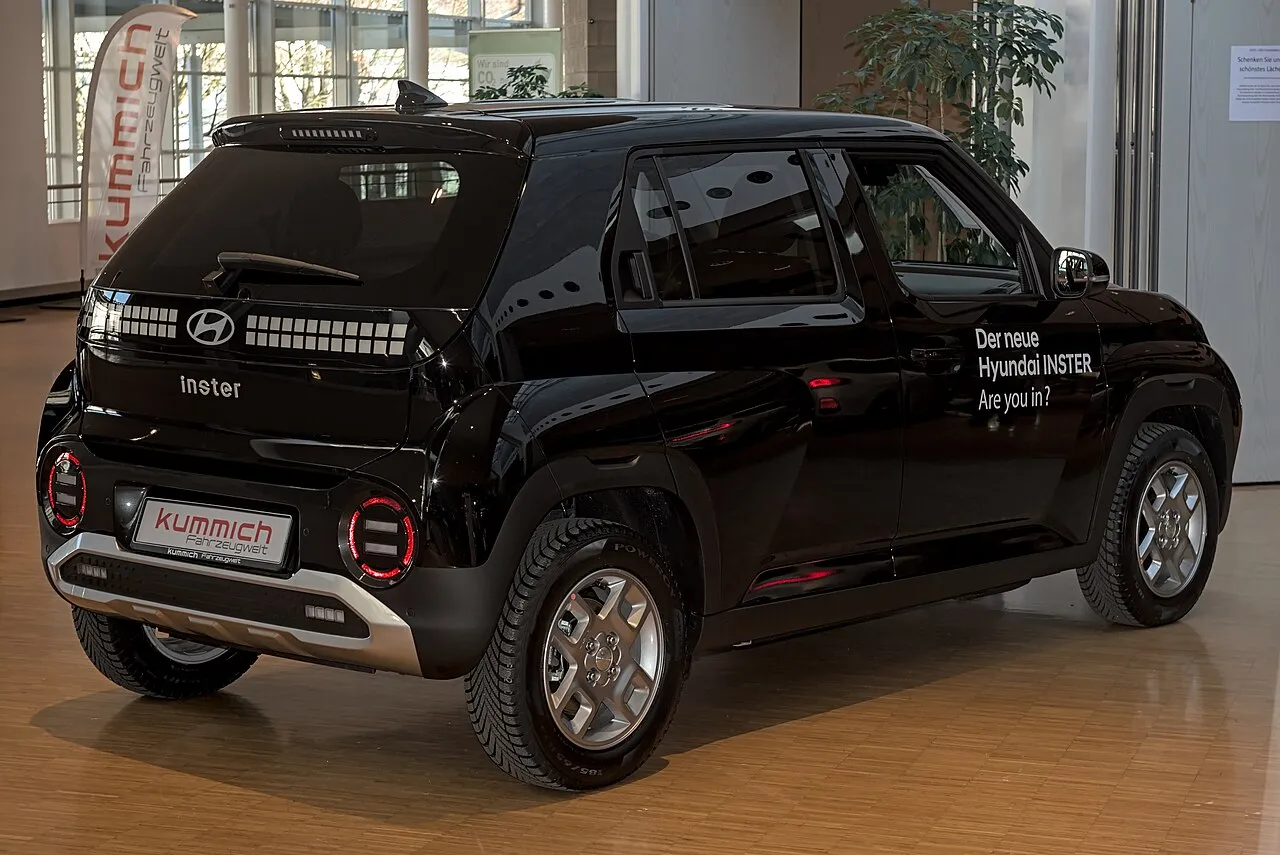
Hyundai already has a compact electric hatchback in the Inster. According to EVDB, the European-market 2025 Inster measures 3,825 millimeters long, with a 2,580-millimeter wheelbase. Those dimensions describe a smaller vehicle than the New Zealand-market Arcfox T1 discussed by EV Central, illustrating the different vehicle sizes involved in the broader search for affordable EVs.
EVDB puts the European Inster Standard’s usable battery capacity at 42 kWh and its WLTP range at 327 kilometers. The Long Range version has 49 kWh of usable capacity and a 370-kilometer WLTP rating. Both European versions have 11-kW AC charging and peak DC charging of 120 kW, according to EVDB. These are European-market figures, separate from any future Australian product decision.
What buyers are still waiting to learn
The next substantive step is confirmation of the vehicles Hyundai intends to bring to Australia, followed by local pricing and launch timing. EV Central’s report establishes the company’s interest in two affordable categories and its preference for exploring Chinese sourcing. It leaves the specific hatchback, the SUV’s relationship to the Kona and any connection to the Arcfox T1 unresolved.
Frequently asked questions
Which cheaper electric vehicles is Hyundai considering for Australia?
According to EV Central, Hyundai is considering China-developed vehicles for the small passenger-car and small electric SUV segments. Model names, Australian prices and launch dates have not been confirmed.
Will a China-sourced SUV replace the Hyundai Kona Electric?
That has not been confirmed. EV Central reported that Hyundai did not explain whether another small electric SUV would supplement or eventually replace the Kona Electric.
Is the Arcfox T1 confirmed as a future Hyundai model?
No. According to EV Central, there is no confirmed connection between the Arcfox T1 and Hyundai’s Australian product plans. A T1 photographed in Australia could also relate to a potential Arcfox launch.
Is Hyundai bringing the Turkish-built Ioniq 3 to Australia?
According to EV Central, Hyundai decided against introducing the Turkish-built Ioniq 3 in Australia after studying its prospects. Hyundai executive Tim Rodgers cited changes in the global business environment, including logistics and transport.
Related stories

GWM Haval H7 PHEV Undercuts Toyota RAV4 PHEV in Australia
GWM’s Haval H7 PHEV pairs a lower Australian starting price with more power and claimed electric range, while Toyota counters with safety features and fuel economy.

Nio Launches ES8 Mirror Black Edition 2.0 in China
Nio’s ES8 Mirror Black Edition 2.0 adds black-and-gold trim and starts at 434,800 yuan in China, while retaining the standard ES8’s core hardware.
German Economist Floats Selling Volkswagen to Chinese Buyers
Moritz Schularick says Germany should consider selling Volkswagen while keeping production at home. No buyer, offer or takeover talks have been reported.