Hyundai IONIQ 5 or Kia EV6: Which Fits and Charges Better?
The IONIQ 5 and EV6 have similar US range and home charging figures. Their shapes differ, but published dimensions alone cannot settle cargo space.
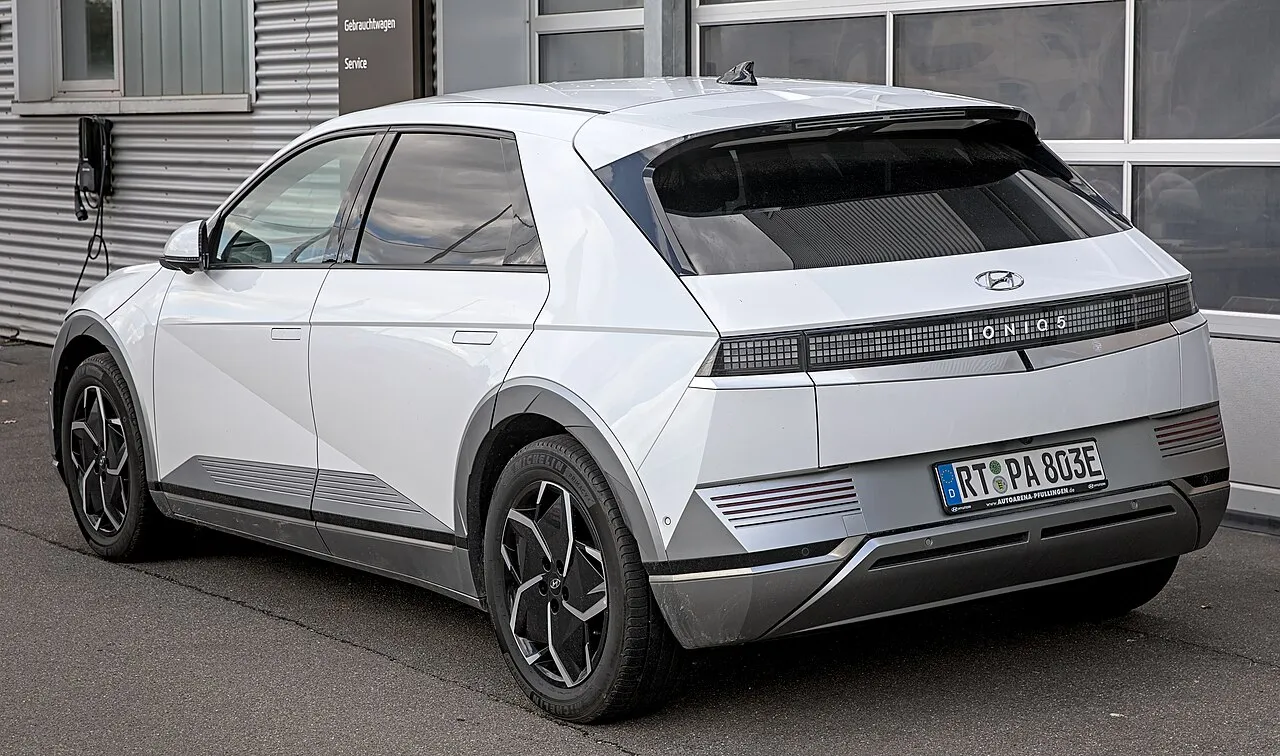
The short answer: For US shoppers, comparable 2027 IONIQ 5 and EV6 versions have closely matched EPA range ratings and Level 2 full-charge times. European dimensions suggest different approaches to packaging, but they do not establish which has the roomier cabin or larger cargo hold.
The Hyundai IONIQ 5 and Kia EV6 are close on the charging figures most useful for comparing these versions: US EPA ratings show similar range and Level 2 full-charge times for comparable 2027 trims. Space is a less certain call. European measurements show a taller IONIQ 5 with a longer wheelbase and a longer, lower EV6, but those exterior dimensions cannot tell a shopper how much luggage or usable cabin space either vehicle has.
That distinction matters because “more space” can mean different things. A driver may care about head clearance, a passenger about legroom, and a family about the shape of the cargo opening. Overall length and wheelbase can help explain a vehicle’s proportions, but neither is a cargo-volume measurement. The most defensible choice from the published figures is therefore a close charging comparison and a conditional space comparison, followed by a check of the particular vehicles under consideration.
Range, charging and exterior measurements
The table keeps US EPA ratings separate from European WLTP ratings. US range and Level 2 full-charge figures are credited to US EPA fueleconomy.gov. European range, charging capabilities and exterior measurements are credited to EVDB. EPA and WLTP range figures use different test standards and should not be compared as equivalent results. No separate test standard is stated for the charging times, charging power or exterior dimensions.
| Vehicle and version | Market and model year | Range and test standard | Level 2 full charge | AC / peak DC charging | Length / height / wheelbase | Source |
|---|---|---|---|---|---|---|
| IONIQ 5 RWD | US, 2027 | 318 mi, EPA | 9.1 hours | — | — | US EPA fueleconomy.gov |
| EV6 Long Range RWD | US, 2027 | 319 mi, EPA | 9 hours | — | — | US EPA fueleconomy.gov |
| IONIQ 5 AWD, 19-inch wheels | US, 2027 | 290 mi, EPA | 8.2 hours | — | — | US EPA fueleconomy.gov |
| EV6 Long Range AWD, 19-inch wheels | US, 2027 | 295 mi, EPA | 8.8 hours | — | — | US EPA fueleconomy.gov |
| IONIQ 5 AWD, 20-inch wheels | US, 2027 | 269 mi, EPA | 8.2 hours | — | — | US EPA fueleconomy.gov |
| EV6 Long Range AWD, 20-inch wheels | US, 2027 | 270 mi, EPA | 8.9 hours | — | — | US EPA fueleconomy.gov |
| IONIQ 5 Standard Range | US, 2027 | 245 mi, EPA | 6.3 hours | — | — | US EPA fueleconomy.gov |
| EV6 Standard Range RWD | US, 2027 | 237 mi, EPA | 6.2 hours | — | — | US EPA fueleconomy.gov |
| IONIQ 5 Long Range AWD | Europe, 2026 | 498 km, WLTP | — | 11 kW / 240 kW | 4,655 / 1,605 / 3,000 mm | EVDB |
| EV6 Long Range AWD | Europe, 2025 | 494 km, WLTP | — | 11 kW / 240 kW | 4,695 / 1,550 / 2,900 mm | EVDB |
What the dimensions say about cabin space
EVDB’s European measurements show that the 2026 IONIQ 5 Long Range AWD is taller and has a longer wheelbase than the 2025 EV6 Long Range AWD. The EV6 is longer overall. Both have the same published width of 1,890 mm. These are measurements of different model years in the European market, so they are a guide to the vehicles’ proportions rather than a dimensional comparison of the US versions in the EPA rows.
Wheelbase is the distance between the axles. A longer wheelbase can give designers more room to arrange occupants within the body, but it does not measure legroom. Overall height can affect the space available above occupants, yet roof shape, floor height and seating position also matter. Likewise, a longer body does not establish that more of its length is available for passengers or luggage. None of those interior measurements follows directly from the exterior figures.
For a shopper, the practical cabin question is whether the seating position works for everyone who regularly rides in the car. Front-seat adjustment changes the space behind it; the shape of the roof affects how the rear seat feels to taller passengers. The European height and wheelbase figures make the IONIQ 5 worth examining if those concerns lead the decision. They do not prove it has more usable rear-seat room than the EV6. The EV6’s greater exterior length is equally insufficient to prove an interior advantage.
Why cargo capacity remains an open question
Cargo volume figures have not been published for the versions compared here. Without them, there is no sound numerical answer to which SUV holds more. Even a volume figure would address only part of the question: a broad, low item may fit differently from a tall box with the same volume. The opening, floor shape and available height can determine whether a particular load fits.
The different exterior profiles make that distinction especially relevant. EVDB measures the European IONIQ 5 Long Range AWD as taller and the European EV6 Long Range AWD as longer. A shopper might expect those shapes to affect the cargo area differently, but the measurements do not reveal the opening or the space behind the rear seats. Nor do they show what happens to usable cargo space when the seats are occupied or folded.
Anyone choosing between them for a stroller, mobility device, pet crate or other recurring load should check that item against the actual cargo area. That is a more specific question than which vehicle has the larger exterior body. It also avoids treating wheelbase as a proxy for trunk size: the space between axles and the space available for luggage serve different purposes.
Home charging: close times, with a trim caveat
US EPA fueleconomy.gov gives the 2027 IONIQ 5 RWD a 9.1-hour Level 2 full-charge time and the 2027 EV6 Long Range RWD a 9-hour time. The AWD versions on 19-inch wheels are rated at 8.2 hours for the IONIQ 5 and 8.8 hours for the EV6. On 20-inch wheels, the figures are 8.2 and 8.9 hours, respectively. These are full-charge figures, so they should not be read as the time needed after every ordinary drive.
The Standard Range versions also have shorter full-charge figures: 6.3 hours for the 2027 US IONIQ 5 and 6.2 hours for the 2027 US EV6 Standard Range RWD, according to US EPA fueleconomy.gov. A shorter full-charge time does not, by itself, establish faster charging hardware. The amount of energy that must be replenished matters. For a home-charging decision, compare the version you would buy and the kind of charging session you expect, rather than treating the shortest full-charge figure as a ranking of the vehicles.
Wheel choice changes the EPA range comparison more visibly than it changes the stated IONIQ 5 Level 2 time. US EPA fueleconomy.gov rates the 2027 IONIQ 5 AWD at 290 miles with 19-inch wheels and 269 miles with 20-inch wheels. The corresponding 2027 EV6 Long Range AWD ratings are 295 and 270 miles. Matching drive layout and wheel size is essential here: otherwise, an apparent difference between the two vehicles may reflect the versions being compared.
DC charging: peak power is only one part of a stop
For the European versions in the table, EVDB records an 11 kW AC charging capability and a 240 kW peak DC charging capability for each Long Range AWD vehicle. That makes their published peak DC figures identical for those European model years. It does not establish that the cars take the same time to complete a highway charging stop, and it does not establish a peak DC figure for the US versions.
Peak power is the highest stated charging rate, not a rate maintained throughout a session. Charging speed can change as the battery fills, and a charger must be able to deliver suitable power for the vehicle to use its capability. A complete stop also depends on how much energy the driver needs before leaving. The EVDB figures therefore support a comparison of stated peak capability, while leaving actual charging-session duration unresolved.
Which one makes more sense?
If range and overnight charging are the leading concerns, the comparable 2027 US versions are closely matched on US EPA fueleconomy.gov figures. The EV6 Long Range RWD has a 319-mile EPA rating against 318 miles for the IONIQ 5 RWD; the AWD pairs are similarly close when wheel sizes match. Those small rating gaps offer little reason to decide before considering the exact trim and its fit for daily use.
If passenger comfort or luggage is the deciding factor, neither exterior dimensions nor charging figures settle the choice. The European measurements explain why the two SUVs may use their footprints differently, but cabin and cargo measurements for the compared versions are still needed for a definitive space ranking. Check the seating position and the load that matters to you in each vehicle. On the published figures alone, charging is a close contest and cargo space has no defensible winner.
Frequently asked questions
Which has more EPA-rated range, the IONIQ 5 or EV6?
It depends on the version. US EPA fueleconomy.gov rates the 2027 EV6 Long Range RWD at 319 miles and the 2027 IONIQ 5 RWD at 318 miles. Comparable AWD versions are also close when wheel sizes match.
Which has the larger cargo area?
Cargo volume figures have not been published for the versions compared here. Exterior length, height and wheelbase cannot establish which has more usable cargo space.
Do the IONIQ 5 and EV6 have the same DC charging peak?
EVDB records a 240 kW peak DC charging capability for both the European 2026 IONIQ 5 Long Range AWD and the European 2025 EV6 Long Range AWD. That figure does not establish their charging-stop times or the capability of US versions.
How long does a full Level 2 charge take?
US EPA fueleconomy.gov gives the 2027 IONIQ 5 RWD a 9.1-hour full-charge time and the 2027 EV6 Long Range RWD a 9-hour time. Times differ by version.
Related stories

How to Choose an EV for Caregiving and Support Trips
Compare passenger access, rear-seat comfort, equipment storage and charging routines to find an EV that fits recurring appointments and support trips.

Choosing 120V or 240V Charging for an EV at Home
A standard outlet may work for an EV that sits parked for long stretches. A 240V setup adds charging power, which can matter when daily driving uses more energy.

How to Plan EV Charging When You Park on the Street
Street parking can work with EV ownership when you confirm local rules, identify dependable charging, and build a routine that fits where you park.