BYD SEALION 7 or Volkswagen ID.5: Space and Power
The SEALION 7 is larger on the outside, but dimensions alone cannot settle rear-seat or cargo fit. Compare the European trims, then check the cabins and hatches.
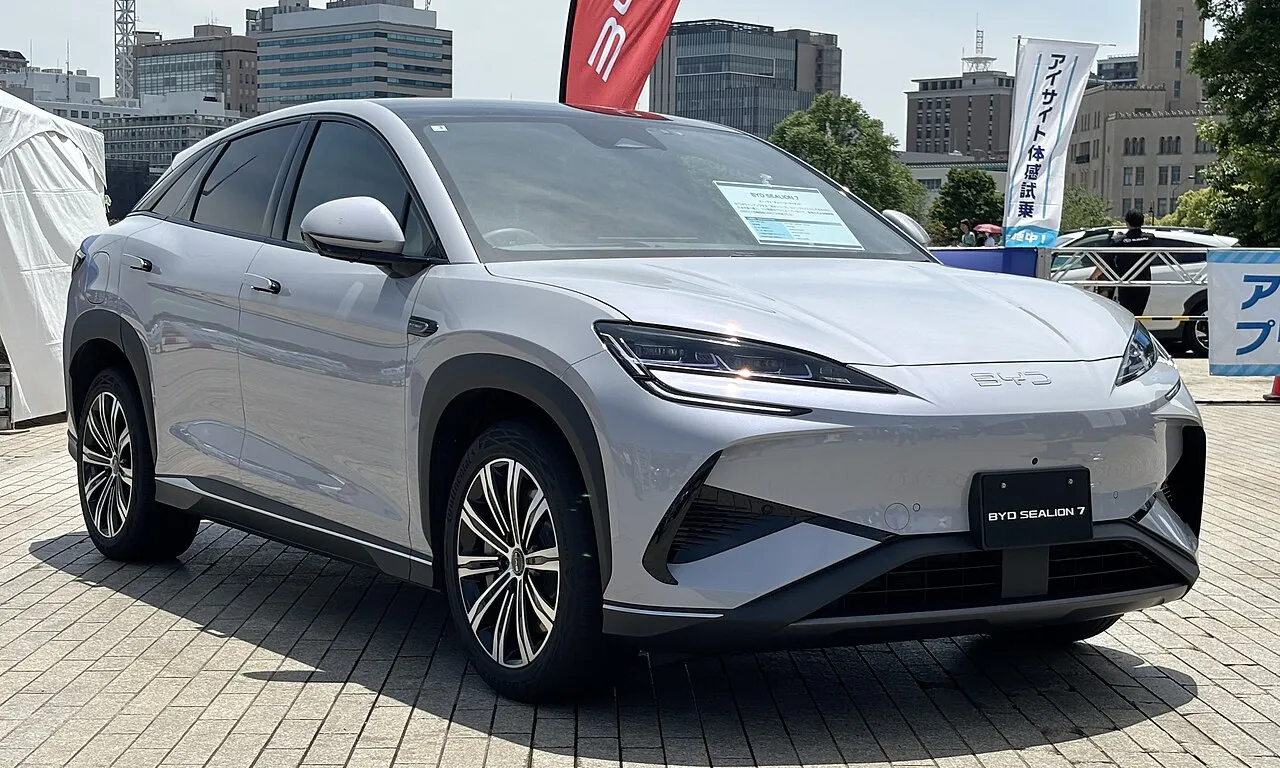
The short answer: The BYD SEALION 7 is longer and wider than the Volkswagen ID.5, but published exterior dimensions cannot establish which has the more useful rear seat or cargo opening. For drivetrain choice, the European 2025 versions span rear-wheel drive and all-wheel drive, with distinct power, range and charging ratings.
The BYD SEALION 7 is the larger of these two sloping-roof SUVs by exterior length, width and wheelbase. That makes it a sensible place to start if rear-seat space is the priority, but it does not prove that a particular passenger will fit more comfortably. The Volkswagen ID.5 has a smaller exterior footprint. For cargo, neither vehicle’s exterior dimensions establish how easily a stroller, suitcase or other bulky item will pass through its hatch. The decisive checks are the rear seat and cargo opening in the actual vehicle.
The drivetrain choice is more concrete. In Europe, the 2025 SEALION 7 Comfort RWD and Excellence AWD differ in battery size, power and DC charging peak. The 2025 ID.5 Pro and GTX also offer rear-wheel-drive and all-wheel-drive choices, respectively, but share the same usable battery capacity and stated DC charging peak. Their published ranges use the same WLTP standard, allowing a comparison of those ratings while leaving real-world range dependent on use and conditions.
European model figures at a glance
EVDB is the source for both SEALION 7 versions. OpenEV Data and EVDB are the sources for both ID.5 versions. Every row below refers to the European market and 2025 model year. Range figures use the WLTP test standard; acceleration figures are for 0–100 km/h. No test standard is stated for the other vehicle measurements and ratings.
| European 2025 version | Battery | WLTP range | Power; torque | 0–100 km/h | AC; peak DC charging | Length; width; height | Wheelbase |
|---|---|---|---|---|---|---|---|
| BYD SEALION 7 Comfort RWD | 69 kWh usable, 71.8 kWh gross; LFP | 502 km | 230 kW; 380 Nm | 6.7 seconds | 11 kW; 150 kW | 4,830; 1,925; 1,620 mm | 2,930 mm |
| BYD SEALION 7 Excellence AWD | 87 kWh usable, 91.3 kWh gross; LFP | 542 km | 390 kW; 690 Nm | 4.5 seconds | 11 kW; 230 kW | 4,830; 1,925; 1,620 mm | 2,930 mm |
| Volkswagen ID.5 Pro RWD | 77 kWh usable, 82 kWh gross; NCM | 520 km | 150 kW; 310 Nm | 8.5 seconds | 11 kW; 135 kW | 4,599; 1,852; 1,618 mm | 2,765 mm |
| Volkswagen ID.5 GTX AWD | 77 kWh usable, 82 kWh gross; NCM | 480 km | 220 kW; 460 Nm | 6.2 seconds | 11 kW; 135 kW | 4,599; 1,852; 1,618 mm | 2,765 mm |
What the dimensions say about seating
EVDB puts both SEALION 7 versions at 4,830 mm long, 1,925 mm wide and 1,620 mm tall, with a 2,930 mm wheelbase. OpenEV Data and EVDB put both ID.5 versions at 4,599 mm long, 1,852 mm wide and 1,618 mm tall, with a 2,765 mm wheelbase. The BYD therefore occupies more space lengthwise and widthwise, while the published heights are close. These are exterior measurements. They describe the vehicle’s footprint, not the dimensions of the seats or the space above a passenger’s head.
A longer wheelbase can give designers more room to arrange a cabin, and greater exterior width can create more opportunity for shoulder room. Neither outcome is guaranteed. Seat thickness, floor height, door shape and where the roof begins to slope all affect how the rear seat feels. A buyer regularly carrying adults in back should sit there with the front seat adjusted for the usual driver, then check knee space, head clearance and the ease of getting through the rear door. That exercise answers a more useful question than wheelbase alone: whether the vehicle fits the people who will use it.
The roofline deserves particular attention in both SUVs. Someone may have enough headroom once seated yet still need to duck when entering or leaving. A child seat brings a different check: the person securing it needs room to reach in and work around the door opening. Published exterior height is nearly the same for these vehicles, so it offers little basis for declaring a seating winner. Check the exact seating position and routine that matter to the household.
Cargo access is more than cargo volume
A sloping roof can make the upper part of a cargo area less useful for tall objects, even where the floor has room for their footprint. The hatch opening also determines whether an item can be lifted in at all. No cargo-volume or hatch-opening measurement is stated here for either SUV, so there is no sound numerical cargo winner. The SEALION 7’s greater exterior length does not, by itself, establish a longer cargo floor or a wider opening.
For a practical comparison, bring the item most likely to cause trouble. Check its width and height against the opening, then consider the lift over the cargo sill and whether the hatch closes with the item in place. A box that clears the opening may still meet the descending hatch or rear glass. If the item must ride with passengers aboard, try it with the rear seats in their normal positions. Folding a seat may solve one cargo problem while removing a place a passenger needs.
Also consider how the load is handled, not only whether it fits. A heavy case may be awkward if it must be raised high or turned to clear the opening. An item used frequently should be easy to remove without rearranging everything around it. Those checks make the distinction between cargo capacity and cargo access tangible. The exterior figures identify which vehicle is larger overall; a hands-on fit check establishes which cargo space works better for a specific load.
How the drivetrains differ
The SEALION 7 Comfort is rear-wheel drive with 230 kW of power and 380 Nm of torque; EVDB gives it a 6.7-second 0–100 km/h time. The Excellence is all-wheel drive with 390 kW, 690 Nm and a 4.5-second time. The ID.5 Pro is rear-wheel drive with 150 kW, 310 Nm and an 8.5-second time, while the all-wheel-drive GTX has 220 kW, 460 Nm and a 6.2-second time, according to OpenEV Data and EVDB. On these published figures, the Excellence has the highest output and quickest stated acceleration of the four.
Power and acceleration describe different things. Power indicates a drivetrain’s rated output; the 0–100 km/h figure describes a particular acceleration run. Neither says how smoothly the vehicle responds in traffic or how a driver will like its controls. All-wheel drive also changes which wheels can receive driving force, but it does not remove the need for suitable tires or careful driving when grip is limited. Choose between the rear-wheel-drive and all-wheel-drive versions according to the conditions and driving behavior that matter, rather than treating the quickest acceleration time as an overall verdict.
Range, batteries and charging
EVDB gives the SEALION 7 Comfort a 502 km WLTP range from a 69 kWh usable LFP battery, and the Excellence a 542 km WLTP range from an 87 kWh usable LFP battery. OpenEV Data and EVDB give both ID.5 versions a 77 kWh usable NCM battery, with 520 km WLTP for the Pro and 480 km WLTP for the GTX. Within this shared test standard, the Excellence has the highest stated range and the GTX the lowest. A WLTP result is a standardized comparison point, not a promise of distance on every trip.
Usable capacity describes the battery energy available for driving, while gross capacity includes energy outside that usable amount. The battery chemistry differs between the BYD and Volkswagen versions, but the chemistry labels alone do not establish an advantage in longevity, charging time or everyday range. The ratings show that drivetrain choice matters as well as battery size: the two ID.5 versions have the same stated usable capacity but different WLTP ranges. Compare the version being considered, rather than assuming a model name carries one range figure.
All four versions have an 11 kW AC charging rating. Their stated peak DC ratings differ: EVDB gives the SEALION 7 Comfort 150 kW and Excellence 230 kW; OpenEV Data and EVDB give both ID.5 versions 135 kW. A peak is the highest stated charging power, not the power held throughout a session. Without a charging-time result over the same battery interval, these peaks cannot establish how long a stop will take. For a shopper weighing trips against cabin needs, the table identifies the rated differences; seating and cargo checks establish which vehicle works in daily use.
Frequently asked questions
Which is larger, the BYD SEALION 7 or Volkswagen ID.5?
For the European 2025 versions, the SEALION 7 is longer and wider and has a longer wheelbase. Their published exterior heights are close. Those dimensions do not establish rear-seat or cargo-opening size.
Which version has the longest published range?
EVDB rates the European 2025 SEALION 7 Excellence AWD at 542 km WLTP, the highest WLTP figure among these four versions.
Do both SUVs offer rear-wheel drive and all-wheel drive?
Yes. The European 2025 SEALION 7 Comfort and ID.5 Pro are rear-wheel drive; the SEALION 7 Excellence and ID.5 GTX are all-wheel drive.
Does the SEALION 7's larger exterior mean it has better cargo access?
Exterior size alone cannot settle that. Check the hatch opening, lift over the sill and clearance under the closed hatch with the items you expect to carry.
Related stories

Chevrolet Blazer EV SS Earns Its Place in SS History
Car and Driver says the 615-hp Blazer EV SS is worthy of Chevrolet’s Super Sport badge, pairing quick acceleration with upgraded brakes and tires.

Nio Launches ES8 Mirror Black Edition 2.0 in China
Nio’s ES8 Mirror Black Edition 2.0 adds black-and-gold trim and starts at 434,800 yuan in China, while retaining the standard ES8’s core hardware.

Subaru E-Outback Starts at £49,995, Deliveries Due in 2027
Subaru has opened UK orders for the all-wheel-drive E-Outback, priced from £49,995. The first customer deliveries are due in early 2027.