How the Hyundai IONIQ 5 and BYD SEALION 7 Compare for Space
The SEALION 7 has the larger exterior footprint, while the IONIQ 5 has the longer wheelbase. Cabin and cargo measurements are needed to settle usable space.
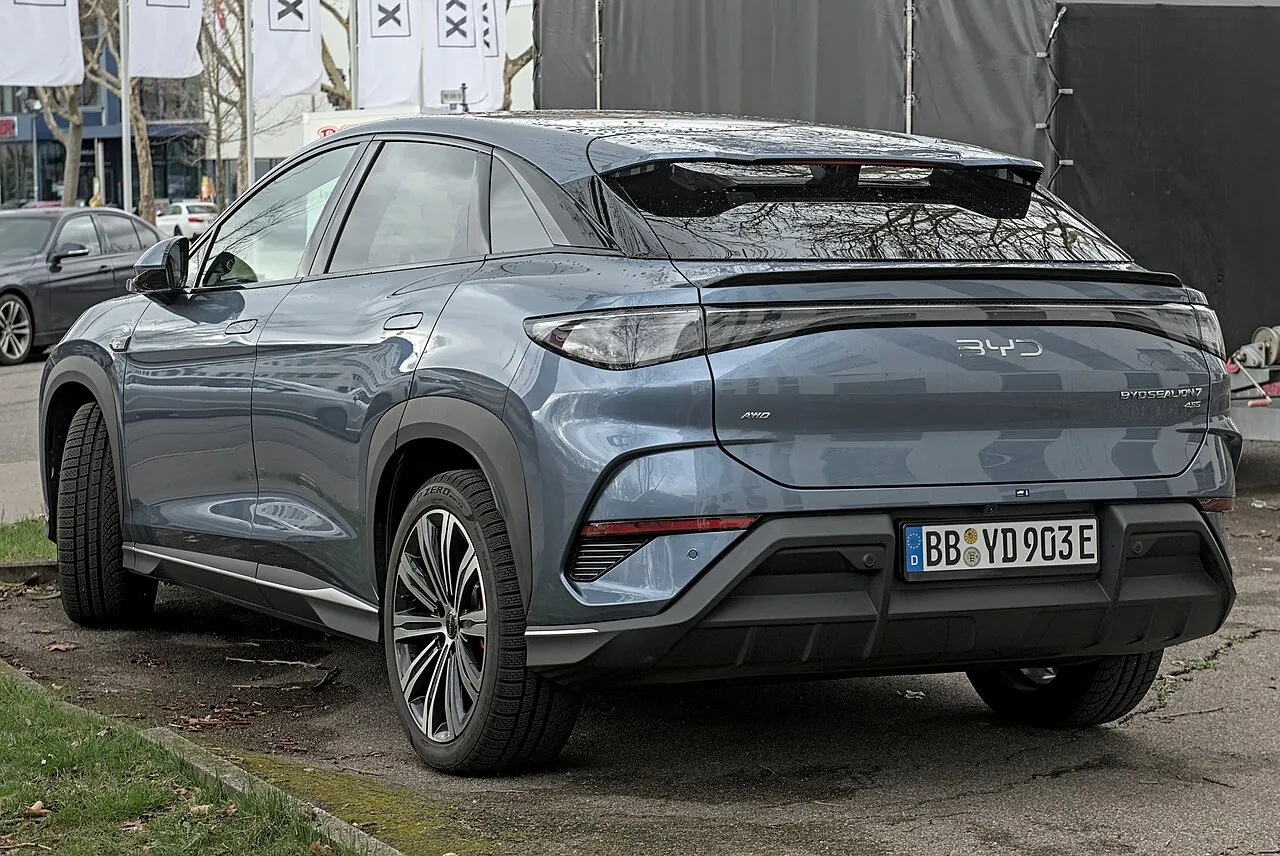
The short answer: EVDB figures show that the European BYD SEALION 7 is longer and wider, while the European Hyundai IONIQ 5 has a longer wheelbase. Those dimensions do not establish which has more passenger room or easier cargo access; published charging figures also vary by version and market.
The BYD SEALION 7 takes up more space on the road, but the Hyundai IONIQ 5 has more distance between its axles. According to EVDB, the European SEALION 7 is longer, wider and taller than the European IONIQ 5 versions shown below. The IONIQ 5 has the longer wheelbase. Neither set of exterior dimensions settles the question a family is likely to care about most: how comfortably people and luggage fit inside.
There is a similar limit to a quick charging comparison. EVDB reports AC and peak DC power for European versions of both vehicles. US EPA fueleconomy.gov reports Level 2 full-charge times for US IONIQ 5 versions. These are different measures: a peak DC power figure is not a charging-stop time, and an AC power rating is not a full-charge time. The table keeps each figure with its market, model year and source.
Dimensions and published charging figures
Dimensions below are exterior measurements, not cabin or cargo measurements. WLTP and EPA identify the test standard for the range figure in each row; they are not test standards for the dimensions or charging figures. A dash means that the particular measure is not shown here for that version.
| Vehicle and version | Market, model year and source | Exterior size: length × width × height; wheelbase | Rated range and test standard | Published charging figure |
|---|---|---|---|---|
| BYD SEALION 7 Comfort RWD | Europe, 2025; EVDB | 4,830 × 1,925 × 1,620 mm; 2,930 mm | 502 km WLTP | 11 kW AC; 150 kW peak DC |
| BYD SEALION 7 Excellence AWD | Europe, 2025; EVDB | 4,830 × 1,925 × 1,620 mm; 2,930 mm | 542 km WLTP | 11 kW AC; 230 kW peak DC |
| Hyundai IONIQ 5 Long Range AWD | Europe, 2026; EVDB | 4,655 × 1,890 × 1,605 mm; 3,000 mm | 498 km WLTP | 11 kW AC; 240 kW peak DC |
| Hyundai IONIQ 5 Standard Range RWD | Europe, 2026; EVDB | 4,635 × 1,890 × 1,605 mm; 3,000 mm | 394 km WLTP | 11 kW AC; 220 kW peak DC |
| Hyundai IONIQ 5 RWD | US, 2027; US EPA fueleconomy.gov | — | 318 mi EPA | 9.1 hours, Level 2 full charge |
| Hyundai IONIQ 5 AWD, 19-inch wheels | US, 2027; US EPA fueleconomy.gov | — | 290 mi EPA | 8.2 hours, Level 2 full charge |
| Hyundai IONIQ 5 AWD, 20-inch wheels | US, 2027; US EPA fueleconomy.gov | — | 269 mi EPA | 8.2 hours, Level 2 full charge |
| Hyundai IONIQ 5 AWD XRT | US, 2027; US EPA fueleconomy.gov | — | 259 mi EPA | 8.2 hours, Level 2 full charge |
| Hyundai IONIQ 5 Standard Range | US, 2027; US EPA fueleconomy.gov | — | 245 mi EPA | 6.3 hours, Level 2 full charge |
These rows describe different markets and model years. In particular, the European IONIQ 5 dimensions and charging-power figures should not be treated as confirmed dimensions or charging-power figures for a US version. There is no US SEALION 7 row here, so the European BYD range and charging figures cannot stand in for a US-market rating.
What the exterior dimensions say about cabin space
EVDB gives both European SEALION 7 trims the same exterior dimensions and wheelbase. Its two European IONIQ 5 versions share a wheelbase, although the Long Range AWD is slightly longer overall than the Standard Range RWD. On these figures, choosing between the two BYD trims does not change the measured exterior footprint. The Hyundai trim choice does affect the reported overall length, so even a comparison of body size needs a named version.
Length matters when judging how much room a vehicle occupies in a garage or parking space. Width matters when opening doors next to another car or a wall. Height can matter where overhead clearance is tight. The SEALION 7’s larger exterior measurements therefore give a useful warning about the space it occupies around the vehicle. They do not reveal its shoulder room, seating position, visibility or how far its doors need to swing for a passenger to get in.
Wheelbase is the distance between the front and rear axles. The IONIQ 5’s longer wheelbase, despite its shorter body, is a reason to investigate its passenger layout closely. It is not a measurement of legroom. The position and shape of the seats, floor, dashboard and rear cargo area all affect how the available length feels to occupants. A longer wheelbase can leave more length between the axles without guaranteeing that any particular passenger gets more usable space.
The comparison is especially sensitive to who will sit where. Front-seat comfort and rear-seat knee room are different questions. So are space for a child seat, room for an adult to enter behind a tall driver, and the ability to carry passengers while keeping the cargo area useful. Exterior length cannot answer any of them on its own. A shopper deciding between these vehicles should treat the dimensions as a starting point for checking the cabin layout, rather than as a ranking of interior room.
Cargo access requires a different comparison
A cargo volume figure, even if available, would answer only part of the luggage question. Access depends on the opening through which an item must pass and the shape of the space beyond it. A suitcase may fit within a cargo area’s total volume yet be awkward to load through its opening. A long item raises a different question: whether it fits with the rear seats in use or requires them to be folded.
The exterior measurements in the table do not establish either vehicle’s cargo volume, opening width, lift-over height or floor shape. They also do not show what happens to usable cargo space when passengers occupy the rear seats. It would be misleading to turn the SEALION 7’s longer body into a claim that it holds more luggage, or to turn the IONIQ 5’s longer wheelbase into a claim that loading is easier.
For a concrete comparison, consider the items that actually determine whether a crossover works: a stroller, luggage, a mobility aid or the equipment carried on a regular trip. Check whether each item clears the opening, whether it can sit securely with the rear seats occupied, and whether the remaining space is usable. For passenger access, check the door opening and seating position with the people who will use them. These checks address the gaps that exterior dimensions leave; no published cargo-access result for either vehicle is established by the figures above.
How to read the charging figures
For the European versions, EVDB reports the same AC charging-power rating for both SEALION 7 trims and both IONIQ 5 trims. AC power describes a charging capability, but it does not give a time to fill the battery. That time depends in part on how much energy needs to be added and the power available at the charging point. The equal AC ratings therefore do not establish equal overnight charging times.
The peak DC figures differ by trim. EVDB reports a higher peak for the SEALION 7 Excellence AWD than for the Comfort RWD, and different peaks for the two European IONIQ 5 versions. A peak identifies a maximum published power, not a rate sustained throughout a session. As charging progresses, power can change, so a higher peak alone cannot establish which vehicle will spend less time at a stop. A charging-time comparison would need a defined starting and ending state of charge under comparable conditions.
For an American shopper, the EPA figures answer a narrower but useful home-charging question. US EPA fueleconomy.gov reports Level 2 full-charge times for the US IONIQ 5 versions in the table. Those times vary by version, while the two AWD wheel choices shown share the same reported time. They should be read as figures for those named US versions, not as a prediction for every home charger or every session. The European AC and peak DC ratings measure something different and cannot be substituted for them.
Range calls for the same care. The BYD and European Hyundai rows use WLTP ratings credited to EVDB. The US Hyundai rows use EPA ratings credited to US EPA fueleconomy.gov. A larger number from one test standard cannot be treated as a directly comparable advantage over a number from the other. Compare versions within a market and test standard first, then consider whether the version whose cabin and cargo access work for you also has charging figures that suit your use.
Which one should a space-focused shopper choose?
Choose the SEALION 7 for its larger measured exterior footprint only if that footprint and its cabin arrangement suit your parking and passenger needs. Consider the IONIQ 5 closely if its longer wheelbase draws your attention to potential passenger space. Neither conclusion establishes a winner for cabin room or cargo access. The decisive comparison requires interior and loading measurements, or a check with the passengers and items the vehicle must carry.
Charging is also a version-specific decision. The European peak-power figures and US Level 2 times answer different questions, while WLTP and EPA ranges follow different test standards. Identify the market and trim first. Then use the appropriate figure for the charging situation you are evaluating, alongside a direct check of the cabin and cargo area.
Frequently asked questions
Is the BYD SEALION 7 bigger than the Hyundai IONIQ 5?
In EVDB’s European figures, the 2025 SEALION 7 is longer, wider and taller than the 2026 IONIQ 5 versions shown. The IONIQ 5 has the longer wheelbase. Exterior dimensions do not establish which has more usable cabin or cargo space.
Which has easier cargo access?
The published exterior dimensions do not establish cargo-opening size, lift-over height or floor shape for either vehicle. Those features need a separate comparison.
Do the European versions have the same AC charging rating?
Yes. EVDB reports 11 kW AC charging for both 2025 European SEALION 7 trims and both 2026 European IONIQ 5 versions shown. That rating does not establish equal full-charge times.
Can the SEALION 7 WLTP range be compared directly with a US IONIQ 5 EPA range?
No. EVDB’s European SEALION 7 figures use WLTP, while US EPA fueleconomy.gov rates the US IONIQ 5 versions using EPA testing. The ratings follow different standards.
Related stories

How to Build a Flexible EV Charging Routine for Work
Build charging around the miles you need for your next drive, using home, work, or public charging as your schedule allows. Keep a practical buffer.

How to Check EV Charger Plug Compatibility Before a Trip
Match your EV’s connector and charging limits to each route stop. Learn what charger labels mean, when an adapter may work, and what to confirm before you leave.

How to Estimate Electric Car Range While Towing
Estimate towing range from your vehicle’s normal range, then adjust for trailer shape, speed, weather and hills. Use the result to plan charging stops.