BYD TANG or Volvo EX90: Which Has the More Usable Third Row?
Compare the BYD TANG and Volvo EX90 for third-row use, with market-specific dimensions and the seating details that matter for access and passenger comfort.
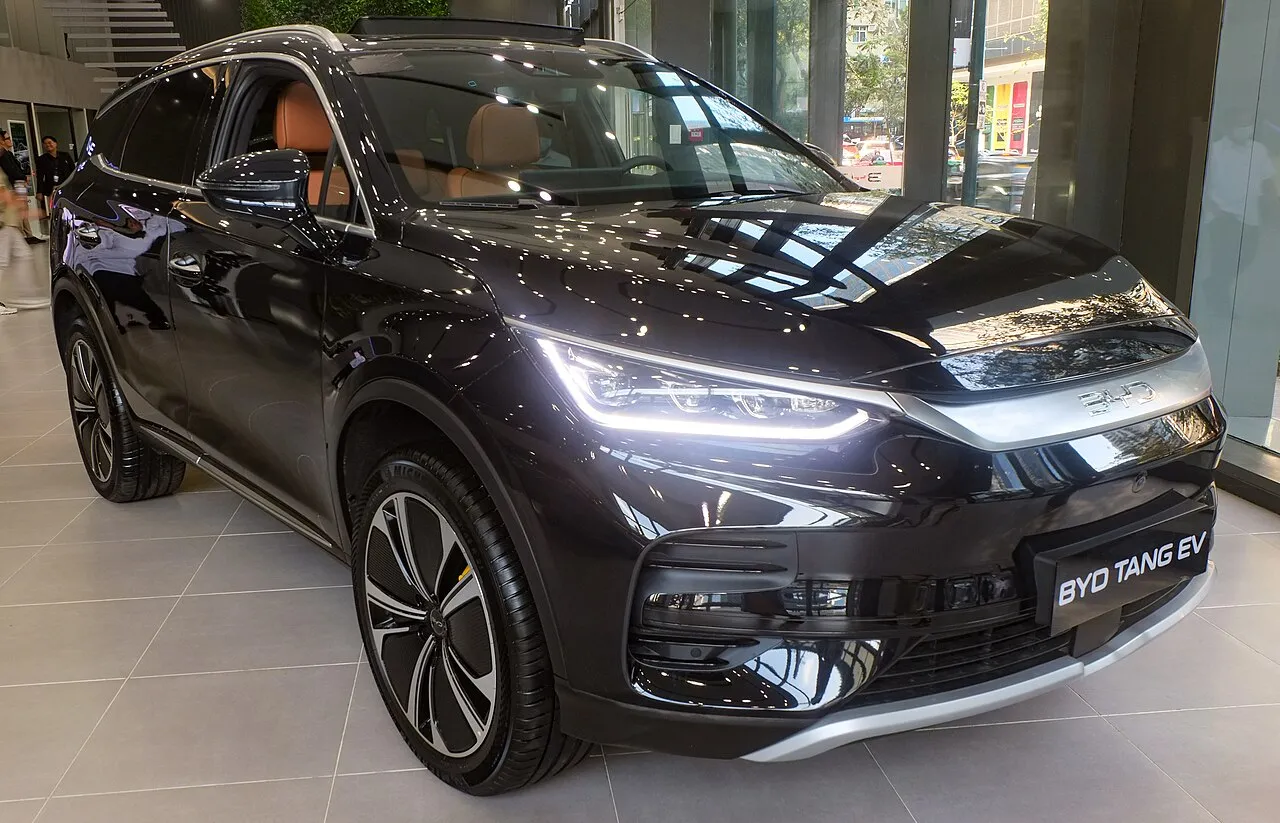
The short answer: Neither the BYD TANG nor the Volvo EX90 can be declared the easier third-row SUV to enter from exterior dimensions alone. The European EX90 has a longer wheelbase, but that does not establish a wider entry passage, more flexible seating or better passenger accommodation.
The Volvo EX90 has the longer wheelbase in the European versions compared here, but that does not establish that its third row is easier to reach or more comfortable than the BYD TANG’s. For seven-seat shoppers, the decisive questions concern the opening behind the second row, how the seats move and how much usable space remains once everyone is seated. Exterior measurements cannot settle those questions.
Market and version also matter. The dimensional comparison below concerns European models, while the American EX90 has separate EPA ratings. Those distinctions prevent a European vehicle’s measurements and an American vehicle’s range rating from becoming an apparently unified description of a different version.
What the dimensions establish
EVDB gives the European 2025 BYD TANG Ev AWD a length of 4,970 mm and a wheelbase of 2,820 mm. For the European 2025 Volvo EX90 Single Motor and Twin Motor, EVDB reports a length of 5,037 mm and a wheelbase of 2,985 mm. That establishes a larger exterior footprint and greater distance between the Volvo’s axles, without establishing how either vehicle allocates its interior space.
There is also a meaningful distinction between the TANG versions. OpenEV Data reports a shorter body for the European 2025 Flagship than EVDB reports for the Ev AWD, although their wheelbase figures match. Keep those versions separate rather than treating either body measurement as universal to the TANG.
| Vehicle and version | Market and model year | Exterior dimensions | Wheelbase | Rated range and test standard | Source |
|---|---|---|---|---|---|
| BYD TANG Ev AWD | Europe, 2025 | Length 4,970 mm; width 1,955 mm; height 1,745 mm | 2,820 mm | 530 km, WLTP | EVDB |
| BYD TANG Flagship | Europe, 2025 | Length 4,870 mm; width 1,950 mm; height 1,725 mm | 2,820 mm | 530 km, WLTP | OpenEV Data |
| Volvo EX90 Single Motor | Europe, 2025 | Length 5,037 mm; width 1,964 mm; height 1,744 mm | 2,985 mm | 580 km, WLTP | EVDB |
| Volvo EX90 Twin Motor | Europe, 2025 | Length 5,037 mm; width 1,964 mm; height 1,744 mm | 2,985 mm | 610 km, WLTP | EVDB |
| Volvo EX90 Twin Motor | US, 2027 | No dimensional comparison made here | No dimensional comparison made here | 300 miles, EPA | US EPA fueleconomy.gov |
Exterior dimensions are physical measurements, not WLTP or EPA test results; the standards in the table apply only to range. The European WLTP ratings and American EPA rating should not be compared as equivalent measures. Neither standard evaluates the ease of reaching a rear seat.
Third-row access depends on the entire path
Reaching a third row involves several separate movements: entering through the rear door, passing the second-row seat and lowering into the rear seat. A restriction at any point can determine how usable the arrangement feels. A long cabin may still have an awkward passage if the second-row seat occupies much of the doorway when moved forward.
The seat’s movement matters as much as its final position. Sliding, tipping and folding perform different jobs. Sliding changes the seat’s position along the floor; tipping changes its angle; folding brings the backrest down. A description of folding capability alone would not establish the size or shape of the passage available to a passenger.
A defensible comparison therefore requires confirmation of the mechanism on the exact TANG and EX90 under consideration. Neither vehicle earns an access advantage merely because its body is longer. The useful distinction is whether the seat movement leaves space for a passenger’s feet, knees and torso while preserving a manageable route through the door.
Exit deserves the same attention as entry. Someone outside can help move a seat before a passenger climbs in, but a rear passenger may need to operate the release independently when leaving. Reachable controls and an unobstructed return path are separate requirements from the ability to fit into the seat once it is ready.
Seating flexibility means more than folding the rear seats
A family’s useful seating arrangement depends on which passengers and belongings must travel together. Folding a rear seat creates a different configuration from carrying occupants across every row. The relevant question is whether the vehicle can accommodate the intended combination while keeping the occupied seats comfortable and accessible.
Seat adjustments can also redistribute space rather than create it. Where a second row slides, moving it forward may improve rear legroom while reducing room for the passenger ahead. A meaningful assessment keeps the front driving position appropriate, then considers the second and third rows together. A roomy-looking third row with the middle seats pushed unusually far forward proves little about normal family use.
Child restraints add another dependency. Whether a second-row seat can move with a restraint attached depends on the vehicle’s instructions, the restraint and its installation. Do not assume either SUV allows that movement, or that a convenient access demonstration applies with the family’s restraints installed. The relevant configuration is the one that remains usable during an ordinary trip.
Similarly, folding flexibility should be assessed with occupied seats in mind. The ability to create a large cargo area does not establish whether a stroller or other essential belongings fit while the rear passengers retain their seats. These are different uses of the same interior, and neither should stand in for the other.
Passenger accommodation goes beyond legroom
The EX90’s longer wheelbase is a reason to examine its cabin packaging closely, rather than proof of superior rear accommodation. Wheelbase does not reveal third-row cushion height, foot clearance or headroom. Body height is equally incomplete because floor position, seat mounting and roof shape all influence the room available around a passenger.
Foot space can be especially consequential. A passenger needs somewhere to place their feet naturally, not simply a gap between their knees and the seat ahead. A low cushion relative to the floor can leave knees raised and reduce thigh support. Those relationships help explain why an exterior size advantage may not translate directly into a comfortable seating position.
Passenger size also changes the result. A position that accommodates a child does not establish adult comfort, while an adult briefly occupying a seat does not establish suitability for a longer journey. The intended rear passengers should be able to sit with the seats ahead adjusted for their actual occupants, rather than for a demonstration.
How American shoppers should interpret the comparison
The European TANG and EX90 measurements provide a bounded comparison of those versions. They should not silently become measurements for every market or model year. Likewise, the American EX90’s EPA rating describes a particular US version’s rated driving range; it does not verify its seating layout or access mechanism.
The most supportable conclusion is that the European EX90 offers a longer wheelbase, while third-row usability remains a question of interior geometry and seat operation. Choosing between these SUVs for rear passengers requires establishing the exact seating configuration, checking the passage with the intended second-row arrangement and evaluating comfort with everyone in position. Until those points are established, neither vehicle has a demonstrated advantage in third-row access or seating flexibility.
Frequently asked questions
Does the Volvo EX90 have a longer wheelbase than the BYD TANG?
Yes, for the European 2025 versions compared here. EVDB reports a 2,985 mm wheelbase for the EX90 Single Motor and Twin Motor and 2,820 mm for the TANG Ev AWD. OpenEV Data also reports 2,820 mm for the European 2025 TANG Flagship.
Does a longer wheelbase prove that the EX90 has easier third-row access?
No. Wheelbase does not establish the door opening, second-row seat movement or passage into the third row. Those features must be assessed on the exact version.
Why are there different lengths for the European BYD TANG?
The figures concern different version and source combinations: EVDB reports 4,970 mm for the European 2025 Ev AWD, while OpenEV Data reports 4,870 mm for the European 2025 Flagship. The figures should remain attached to those versions; a cause for the difference cannot be established here.
Can the European TANG’s WLTP range be compared directly with the American EX90’s EPA range?
No. WLTP and EPA are different test standards. The European 2025 TANG Ev AWD has a 530 km WLTP rating according to EVDB, while US EPA fueleconomy.gov gives the American 2027 EX90 Twin Motor a 300-mile EPA rating.
Related stories

Chevrolet Blazer EV SS Earns Its Place in SS History
Car and Driver says the 615-hp Blazer EV SS is worthy of Chevrolet’s Super Sport badge, pairing quick acceleration with upgraded brakes and tires.

Nio Launches ES8 Mirror Black Edition 2.0 in China
Nio’s ES8 Mirror Black Edition 2.0 adds black-and-gold trim and starts at 434,800 yuan in China, while retaining the standard ES8’s core hardware.
Zeekr 8X Electric SUV Emerges in China Filing
A Chinese regulatory filing points to a battery-electric Zeekr 8X with dual-motor all-wheel drive, while its range, price and Australian plans remain unknown.