BYD ATTO 2 vs Kia EV3: Which Fits Tight Streets Better?
The BYD ATTO 2 is narrower, while the Kia EV3 is slightly shorter. Here is what their dimensions reveal about narrow streets, parking and maneuverability.
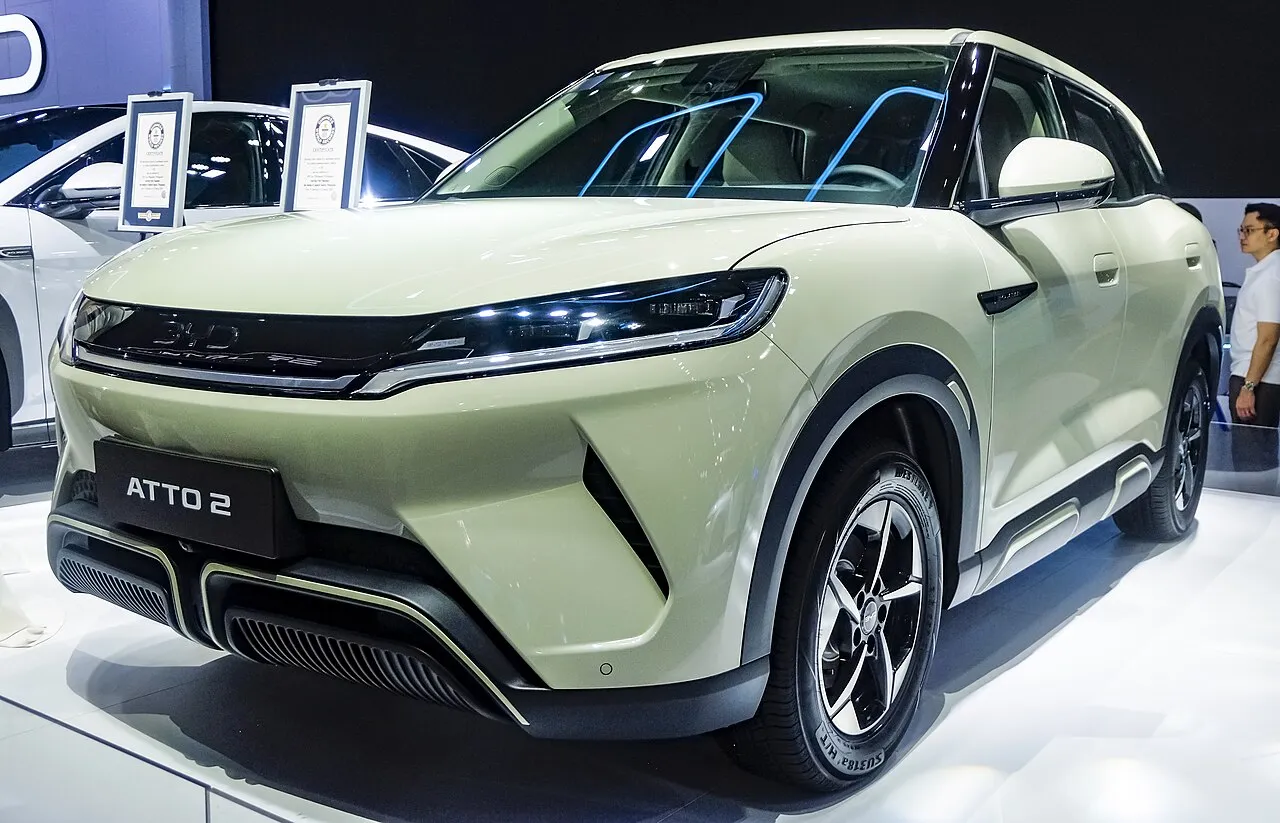
The short answer: For the European 2025 versions, the BYD ATTO 2 has the narrower body, while the Kia EV3 is slightly shorter. That gives the BYD a modest advantage in straight, narrow gaps, but neither can be declared easier to turn or park without turning-circle, visibility and parking-aid details.
The BYD ATTO 2 has a modest body-width advantage for narrow streets; the Kia EV3 has a smaller advantage in overall length for confined parking. EVDB gives the European 2025 ATTO 2 Standard a width of 1,830 mm and length of 4,310 mm, compared with 1,850 mm and 4,300 mm for both European 2025 EV3 versions. Those differences establish which body is narrower and shorter. They do not establish which vehicle can negotiate a tight corner or reverse into a difficult space more easily.
For shoppers, the answer depends on the restriction that causes trouble most often. A narrow passage favors attention to width. A short parking bay favors attention to length. A cramped entrance requires a closer look at steering geometry, the path of the body and the driver's ability to see obstacles.
Exterior dimensions: a small trade-off between width and length
The following comparison uses the European 2025 versions reported by EVDB. Dimensions are expressed in millimeters to preserve the source figures. WLTP is the range-rating standard associated with these versions; it is not a dimensional measurement standard. A separate dimensional measurement standard has not been published.
| Vehicle and trim | Market and model year, applying to every figure | Length | Width | Height | Wheelbase | Standard and source |
|---|---|---|---|---|---|---|
| BYD ATTO 2 Standard | Europe, 2025 | 4,310 mm | 1,830 mm | 1,675 mm | 2,620 mm | Dimensional measurement standard has not been published; range standard: WLTP. Source: EVDB. |
| Kia EV3 Standard Range | Europe, 2025 | 4,300 mm | 1,850 mm | 1,560 mm | 2,680 mm | Dimensional measurement standard has not been published; range standard: WLTP. Source: EVDB. |
| Kia EV3 Long Range | Europe, 2025 | 4,300 mm | 1,850 mm | 1,560 mm | 2,680 mm | Dimensional measurement standard has not been published; range standard: WLTP. Source: EVDB. |
The European 2025 EV3 Standard Range and Long Range share these exterior dimensions, according to EVDB. Choosing between those versions therefore does not change the published body envelope. It would still be a separate question whether their equipment makes a particular parking maneuver easier.
Why the ATTO 2's narrower body can help
Width matters whenever the limiting space lies beside the vehicle: between parked cars, alongside a wall or through a narrow entrance. A narrower body leaves more clearance within the same gap, assuming the vehicles follow the same path. That makes the European 2025 ATTO 2's width advantage relevant to drivers whose regular route involves tight, straight passages.
The practical benefit should remain in perspective. A small body-width advantage does not make an uncertain gap safe to enter. The position of mirrors, projecting obstacles and the driver's ability to judge the far side of the vehicle can matter more than the difference between the published widths.
Mirror-inclusive widths have not been published for this comparison. That prevents a firm judgment about clearance between obstacles at mirror height. Folding mirrors may change a vehicle's widest point, but their operation and the resulting clearance need to be established for the particular version before relying on that possibility.
Parking beside a wall adds another consideration: opening a door. Exterior width describes the closed vehicle. It does not establish how much space occupants need to get out, or whether a door can clear an adjacent obstruction. The BYD's narrower body is useful evidence about fit, but it does not settle everyday access.
Why the EV3's shorter body helps less than it might seem
Length affects how much room remains ahead of and behind a parked vehicle. On that measure, EVDB's European 2025 figures favor the Kia EV3 over the ATTO 2, although the difference is small. In a bay that is already comfortably long enough, that distinction is unlikely to determine the choice.
Parallel parking makes the relationship more complicated. The vehicle must move through an angled path before it reaches its final position. Steering angle, axle position and body overhang influence that path. A shorter vehicle can require more maneuvering than a slightly longer vehicle if its steering geometry is less favorable.
The same distinction applies when entering a garage from a narrow street. Having enough room for the car once it is straight does not guarantee enough room to swing its front end through the entrance. Final parked dimensions and the space required to reach that position are different questions.
Wheelbase does not establish the turning-circle winner
EVDB reports a shorter wheelbase for the European 2025 ATTO 2 than for either European 2025 EV3 version. Wheelbase is the distance between the axles. With other factors held equal, a shorter wheelbase can help a vehicle follow a tighter curve. Other factors, especially the angle through which the front wheels can steer, prevent wheelbase from being a reliable turning-circle ranking by itself.
Turning-circle figures have not been published for the versions compared here. There is consequently no supported basis for saying the ATTO 2 can make a tighter U-turn, or that the EV3 needs more reversing movements in a confined entrance.
The measurement method would also matter if turning figures became available. A curb-to-curb measurement describes a different clearance requirement from a wall-to-wall measurement, which accounts for the body's outer sweep. Comparing figures measured differently could create a misleading advantage. For a street bounded by parked cars or walls, body clearance can be just as important as the path of the tires.
Height cannot tell you which vehicle has better visibility
According to EVDB, the European 2025 ATTO 2 is taller than the corresponding EV3 versions. That establishes overall vehicle height, but it does not establish the driver's eye position, the view over the hood or the size of blind spots near the body.
Visibility depends on the relationship between the seat, windows, pillars, mirrors and bodywork. A driver may have a broad view down the street while still finding a nearby curb difficult to locate. Rearward visibility is another separate issue, particularly when reversing past an obstruction that sits below the window line.
Comparable visibility measurements have not been published for these versions. Neither vehicle can therefore receive a visibility advantage from its height alone. A useful assessment would examine whether the driver can judge the front corners, see approaching traffic around pillars and keep track of low obstacles during reversing.
Parking cameras and sensors remain an unresolved comparison
Version-specific parking-camera and sensor details have not been published for this comparison. It is therefore not possible to credit either model with a reversing camera, surround-view system, particular sensor coverage or automated parking function.
These features answer different parking problems when fitted. Cameras can help a driver locate boundaries within their field of view. Sensors can warn about obstacles within their detection area. Neither changes the physical room needed by the vehicle, and neither establishes that an unseen area is clear.
Equipment availability also needs to match the exact market and trim. A familiar model name does not establish that a particular parking feature is standard on every version. For a shopper whose main concern is a tight driveway, confirming the relevant equipment is more useful than assuming that either SUV's size guarantees easy parking.
Which should narrow-street shoppers favor?
The European 2025 ATTO 2 has the stronger dimensional case when body width is the recurring constraint. The European 2025 EV3 has a slight length advantage, and its Standard Range and Long Range versions occupy the same published exterior space. These are useful distinctions, but neither amounts to a complete maneuverability verdict.
For a tight turn, difficult garage approach or parking space with poor sightlines, the decisive questions remain turning clearance, visibility and confirmed parking equipment. American shoppers should also keep the market distinction in view: the dimensions compared here describe European versions. They do not establish dimensions or equipment for a US-market EV3.
Frequently asked questions
Is the BYD ATTO 2 narrower than the Kia EV3?
Yes, for the European 2025 versions reported by EVDB. The ATTO 2 Standard is 1,830 mm wide, while the EV3 Standard Range and Long Range are 1,850 mm wide. Mirror-inclusive widths have not been published for this comparison.
Which is shorter, the BYD ATTO 2 or Kia EV3?
EVDB reports a length of 4,300 mm for the European 2025 Kia EV3 Standard Range and Long Range, compared with 4,310 mm for the European 2025 BYD ATTO 2 Standard.
Does the ATTO 2's shorter wheelbase mean it turns more tightly?
A shorter wheelbase alone does not establish a tighter turning circle. Steering angle and body clearance also matter, and turning-circle figures have not been published for the versions compared here.
Do the European Kia EV3 battery versions differ in exterior size?
According to EVDB, the European 2025 EV3 Standard Range and Long Range share the same published length, width, height and wheelbase.
Related stories

Choosing an EV That Feels Easy to Place at Low Speeds
Compare accelerator response, sightlines, turning circle and parking aids in the places that matter: tight lots, driveways and slow, confined streets.

Chevrolet Blazer EV SS Earns Its Place in SS History
Car and Driver says the 615-hp Blazer EV SS is worthy of Chevrolet’s Super Sport badge, pairing quick acceleration with upgraded brakes and tires.

Nio Launches ES8 Mirror Black Edition 2.0 in China
Nio’s ES8 Mirror Black Edition 2.0 adds black-and-gold trim and starts at 434,800 yuan in China, while retaining the standard ES8’s core hardware.